Well water services
Full panel testing, treatment trains, pump and tank service.
How it works.
Private wells are not regulated by the EPA — the homeowner is fully responsible. We run a full well panel (arsenic, bacteria, nitrate, VOCs where indicated, metals), diagnose flow and pressure issues, design the right treatment stack, and put the whole system on a service calendar.
Unlike public water systems, private wells are not regulated by the EPA — the homeowner is entirely responsible for testing and treatment. In Oregon, the only required testing happens at real-estate transfer (arsenic, nitrate, and total coliform) and even then the test may be a decade old by the time a new issue appears.
CDC, EPA, and OSU Extension recommend: every year — total coliform bacteria, nitrate, and a field observation (smell, color, sediment, scale); every 3-5 years — arsenic, lead, radon, fluoride, uranium, pH, hardness, iron, manganese, TDS; as needed — VOCs if near industry or a wildfire burn zone, pesticides if agricultural; after any event — flood, new neighboring construction, wildfire, earthquake, taste or smell change, pump replacement.
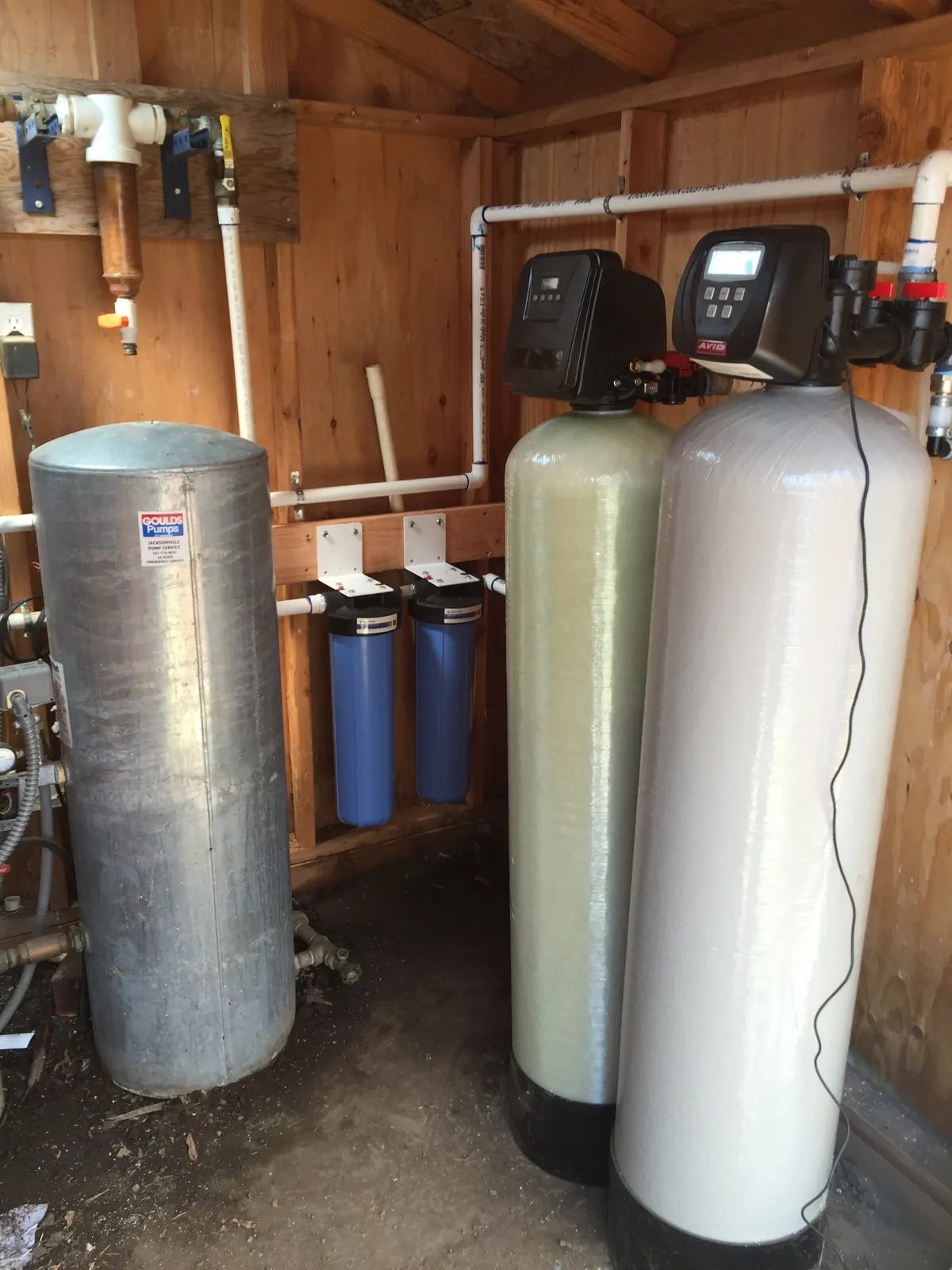
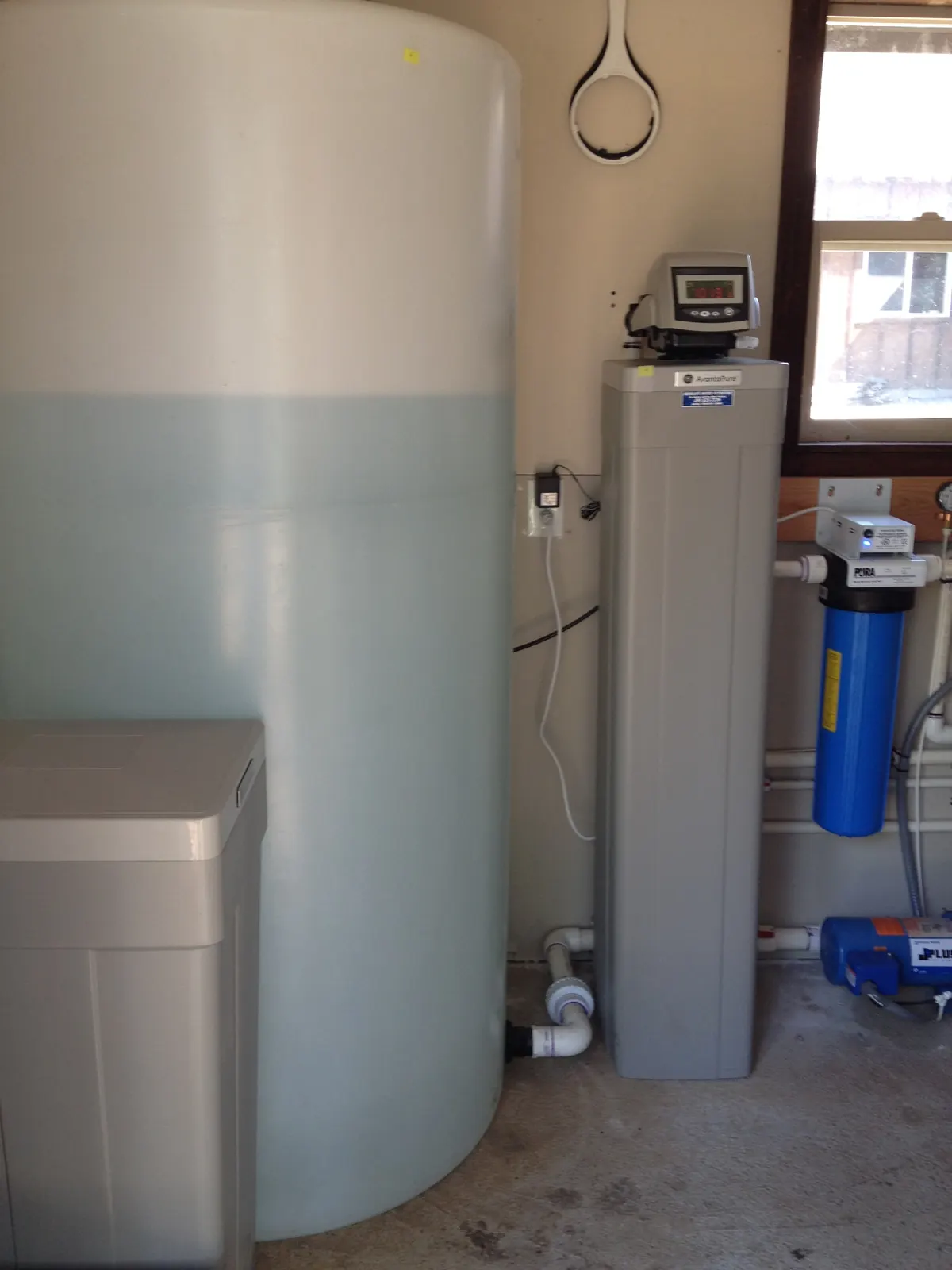
A typical treatment stack for a problem well runs sediment pre-filter → oxidation (if iron / manganese / H2S) → contact tank → backwashing media filter → softener or salt-free conditioner → UV or inline chlorination → point-of-use RO for final polish. We run a full well panel (on-site plus certified lab), diagnose pump/tank/pressure separately from water quality, and put the whole system on a service calendar — annual bacteria/nitrate retests, UV bulb changes, media backwash adjustment, RO membrane replacement.
From recent jobs.
Symptoms we see most often
- Pump cycling on and off rapidly
- Loss of pressure at fixtures
- Property transfer test decades old
- Post-flood, post-fire, or post-construction concern
Every well water services job
- Full panel test — on-site plus certified lab
- Pump, bladder tank, and pressure switch check
- Custom pretreatment + filtration + UV stack
- Annual bacteria / nitrate retest, UV bulb swap
Special considerations by city
Every city in our service area has its own water chemistry, source, and history. Pick your city for the specific numbers, regulations, and recommendations that shape how well water services should be configured at your address.
Eight cities served across the Rogue and Klamath basins. Tap a row to expand.
Medford
Medford city water is clean, but the outer Rogue Valley (East Medford, White City direction, Sams Valley, Shady Cove direction) is well country.
In July 2024 OPB documented that the Rogue Meadows mobile home park public well in Shady Cove exceeded the arsenic MCL in 2020, 2021, and 2023 — with one sample at twice the federal limit (OPB 2024). Oregon Environmental Council notes Jackson County is among the state's highest for well arsenic and nitrate exceedances. Well panel priorities match Eagle Point: arsenic, bacteria/nitrate, iron/manganese, H2S, hardness.
Ashland
Outside Ashland city limits — Dead Indian Memorial Road, Emigrant Lake area, Hyatt/Howard Prairie direction, the hills south and west — private wells drill into decomposed granite and metamorphic bedrock of the Klamath/Siskiyou terrain (Pure Water Solutions).
The same county-wide 44% arsenic detection rate applies, with documented Rogue Valley MCL exceedances (Gold Hill 11.7 ppb, Grants Pass 18.1 ppb, Jacksonville 32.1 ppb) as the reference range. Rural Ashland well panel priorities: arsenic, bacteria/nitrate, hardness (these wells vary widely), iron/manganese, H2S, pH.
Central Point
Outside Central Point's 6,956-connection city service area, rural parcels on the Agate Desert and the foothills pull groundwater from alluvial-basalt aquifers of variable quality. OSU's "Be Well" project is a 4,000-household Jackson County study specifically built around the county's elevated arsenic and nitrate profile, funded by a $1.2M NIEHS grant (OSU College of Health).
The Mail Tribune survey cited in the study reported 22% of Jackson County wells had arsenic (6% at health-concern levels) and 21% had elevated nitrate (Oregon Environmental Council). Rural Central Point well panel priorities: arsenic, nitrate, bacteria, iron/manganese, and hardness.
Eagle Point
Jackson County has roughly 30,000 residential wells (Jackson County Watermaster), and rural parcels outside the 3,477-connection Eagle Point city system are almost entirely on private wells. Local geology is the story:
- The Agate Desert under Eagle Point has an Agate-Winlo silica-cemented duripan 20-30 inches below the surface (Oregon DSL Agate Desert Vernal Pool report). That hardpan traps shallow groundwater and forces reliable wells deep into Western Cascades volcanic bedrock.
- That volcanic rock is the classic arsenic-bearing lithology for Southern Oregon. USGS-referenced data finds arsenic in 44% of Jackson County wells tested (Pure Water Solutions).
- Iron, manganese, and H2S co-occur in reducing groundwater here (Oregon OHA).
Eagle Point well panel priorities: arsenic, bacteria/nitrate, iron/manganese, H2S, pH.
Jacksonville
Jacksonville is surrounded by arsenopyrite-bearing gold-belt lithologies (Galice and Applegate formations) that made the area mineable in the 1850s — and that put arsenic into modern wells. One documented Jacksonville well tested at 32.1 ppb — 3.2x the federal MCL (Pure Water Solutions).
The historic mining district (Jackson Creek, Rich Gulch, Daisy Creek, Kanaka Flats, Forest Creek, Sterling Creek) produced roughly 495,000 ounces of gold between 1852-1959 (Western Mining History), disturbing the same rocks and leaving legacy mercury in stream gravels. Wells in Ruch, Kanaka Flats, Forest Creek, and along Highway 238 deserve a full panel: arsenic, mercury, bacteria/nitrate, iron/manganese, H2S.
Talent
Rural Talent has two overlapping well-service stories:
- Baseline Jackson County risks — arsenic from volcanic geology (44% of county wells positive), nitrate in irrigated valley parcels, occasional H2S.
- Almeda Fire legacy — Oregon Health Authority offered free testing for wildfire-impacted domestic wells covering bacteria, nitrate, arsenic, lead, and BTEX (benzene, toluene, ethylbenzene, xylenes) (OHA — Wildfire-Impacted Well Testing). OHA guidance specifically notes wells may need retesting over time because nearby septic failures and surface chemicals can migrate in long after the event.
Any Talent-area rural well sampled once in 2020 or 2021 is worth re-testing now.
White City
White City is the single most distinctive well-service market in this list, for a reason that's not geologic. The community sits on the Agate Desert (same volcanic aquifer as Eagle Point and Central Point, with the same 44% county-level arsenic detection rate), and on one of the densest concentrations of DEQ Environmental Cleanup Site Information (ECSI) listings in Oregon:
- Vickers / Aeroquip / Eaton (7638 Pacific Ave.) — ongoing off-site groundwater plume migration investigation of TCE, PCE, DCE (DEQ ECSI Site 2281).
- Balteau Standard (8001 Table Rock Rd.) — dichloroethylenes at 27,000 ppb and 1,1,1-trichloroethane at 13,000 ppb in groundwater; PCBs to 140,000 ppm in soil (DEQ ECSI Site 533).
- Cascade Wood Products (8399 14th St.) — pentachlorophenol plume, groundwater up to 25,000 ppb, plume extending west toward Ken Denman Wildlife Refuge (DEQ ECSI Site 20).
- Georgia-Pacific Resins (1405 Antelope Rd.) — formaldehyde and methanol in groundwater (DEQ ECSI Site 287).
- Whetstone Industrial Park — former Camp White and City of Medford solid-waste landfill with dioxin in ash and lead at 830 ppm in soil (DEQ ECSI Site 1465).
White City well panel priorities: arsenic, bacteria/nitrate, VOC scan (TCE, PCE, DCE, TCA, methylene chloride, benzene, PCP), iron/manganese, hardness. Treatment often requires carbon + RO regardless of whether arsenic is found.
Phoenix
Outside Phoenix's small city service area, rural parcels in Coleman Creek, Anderson Creek, the foothills toward Talent, and the Bear Creek floodplain are on private wells in volcanic and alluvial geology that carries the same regional arsenic and iron/manganese signal as the rest of Jackson County — 44% of tested wells positive for arsenic (Pure Water Solutions citing USGS).
Almeda-impacted wells deserve special attention: Oregon Health Authority offered free testing covering bacteria, nitrate, arsenic, lead, and BTEX for wildfire-impacted domestic wells (OHA — Wildfire-Impacted Well Testing); wells sampled once in 2020 or 2021 are worth re-testing now. Phoenix well panel priorities: arsenic, bacteria/nitrate, BTEX (post-fire parcels), iron/manganese, H2S.
Shady Cove
Shady Cove is one of the highest-priority well-service markets in our service area. The Rogue Meadows arsenic case (above the federal 10 ppb MCL in 2020, 2021, and 2023) is the published example, but the same Western Cascades volcanic geology applies to nearly every private well in the area (OPB 2024).
Recommended Shady Cove well panel: arsenic (with As(III) / As(V) speciation), bacteria/nitrate, iron/manganese, hardness, H2S, and pH. A typical treatment stack runs sediment pre-filter → oxidation (if iron / manganese / H2S) → backwashing media filter → softener or salt-free conditioner if needed → UV or shock-chlorination → point-of-use RO at the kitchen.
Gold Hill
Gold Hill is in the heart of the Rogue Valley gold belt. The same arsenopyrite-bearing Galice and Applegate-formation rocks that produced gold from 1850 onward now release arsenic to wells — and Gold Hill is one of three cities (with Jacksonville at 32.1 ppb and Grants Pass at 18.1 ppb) with a documented well exceedance of the federal arsenic MCL: one Gold Hill well at 11.7 ppb (Pure Water Solutions citing USGS).
Recommended Gold Hill well panel: arsenic (with speciation), bacteria/nitrate, iron/manganese, mercury (legacy mining), H2S, and hardness. A typical treatment stack runs sediment pre-filter → oxidation (for iron/manganese/H2S) → adsorptive media for arsenic → softener or TAC if needed → UV or shock chlorination → kitchen-tap RO.
Grants Pass
Josephine County's well universe carries the same regional southern Oregon arsenic signal as Jackson County, with one Grants Pass well documented at 18.1 ppb arsenic — 1.8x the federal MCL (Pure Water Solutions citing USGS).
The Pure Water Solutions / USGS-referenced review reports arsenic detected in 17% of wells across the broader Rogue Basin sample (vs. 44% for Jackson County's denser sample). Grants Pass-area well panel priorities: arsenic (with As(III)/As(V) speciation), bacteria/nitrate, iron/manganese, hardness, H2S, and pH. Treatment matches the test results — adsorptive media for arsenic, oxidation plus filtration for iron/H2S, RO at the kitchen as the universal finisher.
Klamath Falls
Klamath Basin wells are in a class of their own. USGS SIR 2024-5029 documents arsenic in basin waters ranging from 0.03 to 36.7 µg/L (3.7x the EPA MCL) at spring and well sites including Wood Kimball Spring, Fort Creek, and Crooked Creek (USGS SIR 2024-5029).
The second story is drought: groundwater levels in the basin have dropped 30-60 feet since the early 2000s, and in 2021 Klamath County registered 185 dry wells by August alone (OregonLive). The county runs a Domestic Well Financial Assistance Grant covering up to $40,000 (75%) of well rehab (Klamath County — Dry or Failing Wells) — Absolute Water Filtration can coordinate with that program.
Klamath Falls well panel priorities: arsenic, uranium, fluoride (natural, geothermal source), H2S in deeper wells, nitrate in agricultural zones, pump and flow testing on any well that's seen a drought-year drop.
Three visits. Done right.
- 01
Free on-site test
We test your tap or well for the contaminants that actually apply to your city and geology — not a generic 14-panel sticker.
- 02
Right-sized install
Flow rates, household size, and symptom priorities decide the system. Sourced from certified NSF manufacturers — never a one-size pitch.
- 03
Annual checkup
We come back once a year to swap media, retest the water, and catch anything small before it grows.