Salt-free scale conditioners
Template-assisted crystallization — no brine, no salt bags.
How it works.
TAC media converts dissolved calcium and magnesium into microscopic crystals that pass through plumbing instead of coating it. No salt, no wastewater, no electricity on most models. It's the right call for low-hardness city water, tankless water heaters, and homes where brine discharge is a problem.
A salt-free softener is technically not a softener — it doesn't remove calcium or magnesium. It's a scale conditioner. The standard technology is Template-Assisted Crystallization (TAC): media with nucleation sites that convert dissolved hardness minerals into microscopic crystals that flow harmlessly through pipes and fixtures instead of coating them. Your water will still test hard on a strip — the minerals are still there. What changes is whether they stick.
Pros vs a salt-based softener: no salt or potassium to buy, no brine tank, no salt delivery, no wastewater or brine discharge (relevant to septic), no sodium added to drinking water, no slippery "soft water" feel, and lower maintenance (media lasts 5+ years). Cons: water still feels hard in showers and laundry, soap lathers less, doesn't remove iron or manganese, and very high hardness or iron reduces performance.
Some California cities have banned salt-regenerating softeners because chloride in brine discharge damages water reclamation. Oregon has no statewide ban yet, but the policy tide is moving that way. We confirm TAC is right for your water with a quick feed-water test; install is simple — no drain line, no electricity on most models.
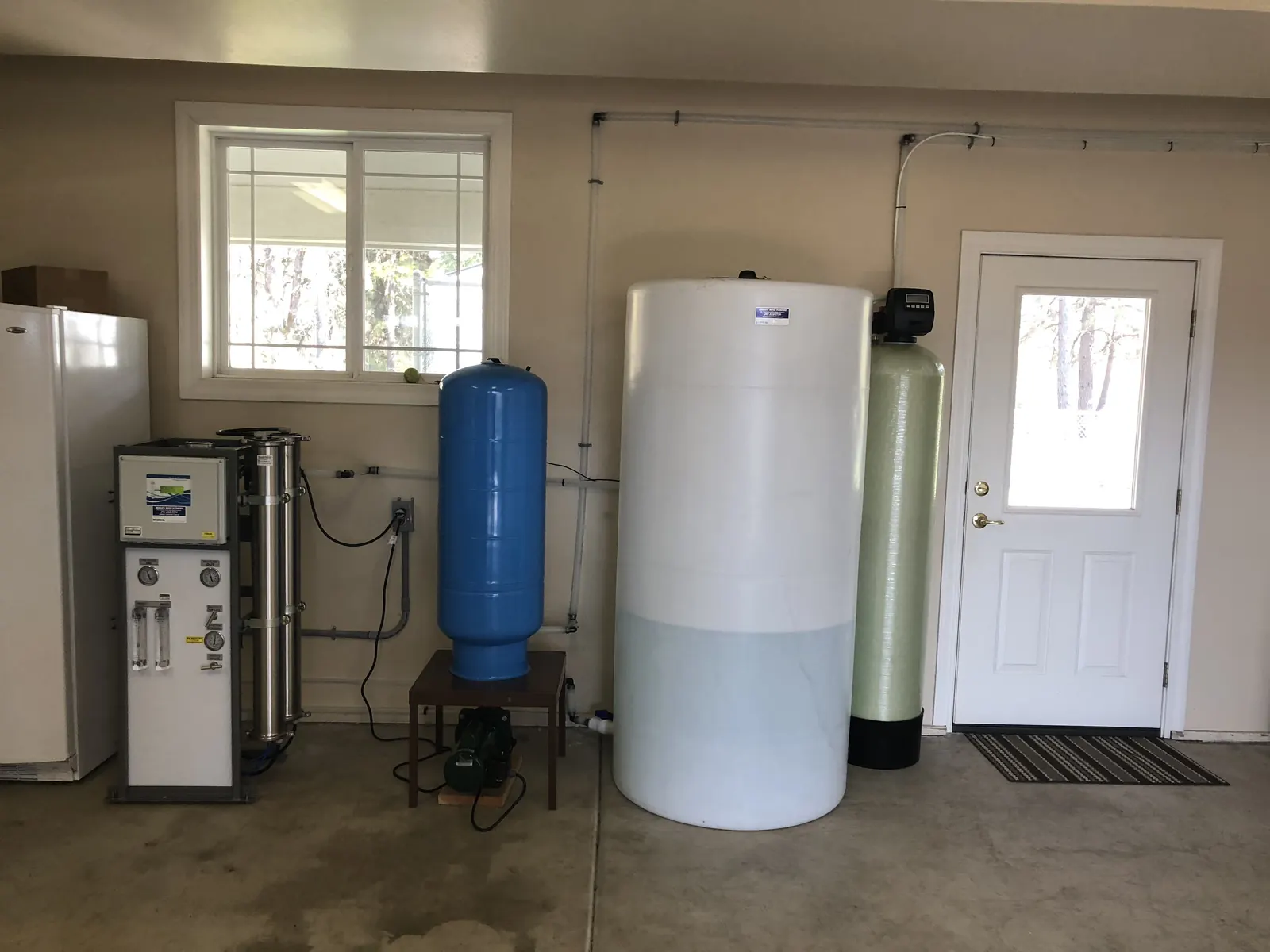
From a recent job.
Symptoms we see most often
- Low-sodium diet in household
- No drain available for a salt softener
- Tankless water heater scale concerns
- Vacation home or rental — don't want to haul salt
Every salt-free scale conditioners job
- TAC media tank, no regen cycles
- Sediment prefilter
- 5-year-plus media life
- Zero brine discharge, septic-safe
Special considerations by city
Every city in our service area has its own water chemistry, source, and history. Pick your city for the specific numbers, regulations, and recommendations that shape how salt-free scale conditioners should be configured at your address.
Eight cities served across the Rogue and Klamath basins. Tap a row to expand.
Medford
Medford residents in new-construction homes with tankless water heaters are the niche case. Tankless units concentrate scale faster than storage tanks, and even 2 gpg builds up over years.
Salt-free TAC is a low-maintenance hedge. Otherwise the ROI argument is weak on Medford's soft water.
Ashland
Three reasons TAC gets more interesting in Ashland than elsewhere:
- Ashland does not publish a hardness value in its 2023 CCR (Ashland 2023 CCR). Surface snowmelt off granite is usually very soft, but homes with heavy appliance wear may want low-maintenance scale protection regardless.
- Ashland's TAP intertie activates every drought summer since 2021, bringing in Medford Water's slightly more mineralized Big Butte Springs / Rogue River supply (Ashland Chronicle — TAP Begin). TAC smooths over that seasonal chemistry change.
- Ashland residents tend toward eco-conscious choices — no brine to discharge, no salt to buy, no electricity to plug in.
Central Point
City water in Central Point is too soft to justify a salt-free conditioner for scale reasons alone.
The honest conversation for most Central Point city customers is: you don't need a softener or a conditioner — you'd benefit more from a carbon filter and RO.
Eagle Point
Eagle Point's city water is 1.4-2.4 gpg (Medford Water FAQ) — very low. A salt-free conditioner is marginal value for average homes.
It's reasonable for homes with tankless water heaters (which accumulate scale faster than tanks even at low hardness) or for residents who want a minimal-maintenance hedge against lifetime appliance wear.
Jacksonville
Jacksonville's municipal water is 1.4-2.4 gpg — a salt-free conditioner is largely cosmetic.
Where it earns its keep is in homes with tankless water heaters or homes on private wells with moderate hardness and a septic system (where salt discharge is a concern).
Talent
A salt-free conditioner is a plausible comfort upgrade for Talent city customers who want scale control without adding sodium to already-soft water.
It pairs cleanly with a whole-home carbon filter for chlorine taste/odor and the post-Almeda VOC concern.
White City
On Medford Water — same answer as Medford proper, rarely justified.
On a private well, it depends entirely on the well's test: if hardness is moderate (4-8 gpg) and iron is low, TAC is a good no-brine option.
Phoenix
Phoenix city water is too soft for a salt-free conditioner to do meaningful scale work. Where TAC earns its keep here is in tankless water heater installs (which concentrate scale faster than tank heaters even at low hardness) and in homes that want a brine-free hedge against lifetime appliance wear.
It pairs cleanly with whole-home carbon for chlorine taste and the post-Almeda VOC concern in rebuilt zones.
Shady Cove
Salt-free TAC fits the rural-well, septic-tank pattern common around Shady Cove: no brine discharge, no salt delivery, no electricity required on most models. It's a reasonable hedge for moderate-hardness wells (4-8 gpg) without iron, where the priority is appliance protection rather than the slick "soft" feel of an ion-exchange softener.
For wells with iron above ~0.3 mg/L or hardness above ~10 gpg, ion-exchange softening with appropriate pretreatment outperforms TAC.
Gold Hill
Salt-free TAC is reasonable for Gold Hill homes with tankless water heaters or on septic systems where brine discharge is a concern. It's not a softener — water still tests hard on a strip — but it controls scale at fixtures and in piping.
Wells with elevated iron (above ~0.3 mg/L) or hardness above ~10 gpg outperform TAC's range; ion exchange with pretreatment is the answer there.
Grants Pass
Salt-free TAC is appropriate for Grants Pass homes with tankless water heaters and for households on septic where brine discharge is a concern. It's also the right call for mid-range hardness (4-8 gpg) without iron — common in some Josephine County valley wells.
For higher-hardness or iron-bearing wells, ion-exchange softening with appropriate pretreatment outperforms TAC.
Klamath Falls
There are two interesting fits here. First, homes on the harder city wells — Balsam (~7.6 gpg) and Homedale (~8.2 gpg) — have a real scale problem.
Second, Klamath Falls is the only city in the list with 500+ private geothermal heating wells serving 600+ structures (OSTI — Klamath Falls Geothermal District Heating). Residential geothermal-loop water runs high silica (up to 100 mg/L, vs ~35 mg/L in ambient groundwater) (USGS — Low-Temperature Geothermal Waters at Klamath Falls). Silica scale is genuinely hard to control; TAC helps on the potable side, and we pair it with appropriate loop-water treatment for the geothermal side.
Three visits. Done right.
- 01
Free on-site test
We test your tap or well for the contaminants that actually apply to your city and geology — not a generic 14-panel sticker.
- 02
Right-sized install
Flow rates, household size, and symptom priorities decide the system. Sourced from certified NSF manufacturers — never a one-size pitch.
- 03
Annual checkup
We come back once a year to swap media, retest the water, and catch anything small before it grows.