Water softeners
Ion exchange for real hardness, sized to your water.
How it works.
A proper softener pays for itself in water heater and appliance life — but only if it's actually needed and correctly sized. We run a lab hardness test, check for iron and manganese (which foul resin), and configure metered demand-based regeneration that uses a fraction of the salt of timer-based units.
A softener removes calcium and magnesium — the minerals that make water "hard" — using ion-exchange resin that swaps hardness ions for sodium (or potassium). Water leaves the softener at roughly 0 grains per gallon. Hard water costs real money: scale in water heaters, reduced appliance life, spotted dishes, less effective soap.
USGS and WQA classify hardness as soft (0-1 gpg), slightly hard (1-3.5), moderately hard (3.5-7), hard (7-10.5), and very hard (10.5+). Sizing is straightforward: people × 75 gal/day × gpg hardness sets the daily grain demand. Residential softeners are typically 24,000-64,000 grains. If your well carries iron or manganese you need a larger unit, specialty resin, or pretreatment — iron fouls standard softener resin.
We install with a bypass valve so service doesn't shut off your home, and configure metered ("demand-based") regeneration — which uses dramatically less salt than a timer. We handle potassium chloride conversions for sodium-restricted homes, schedule salt delivery, and service valves and resin beds on a preventive calendar.
From recent jobs.
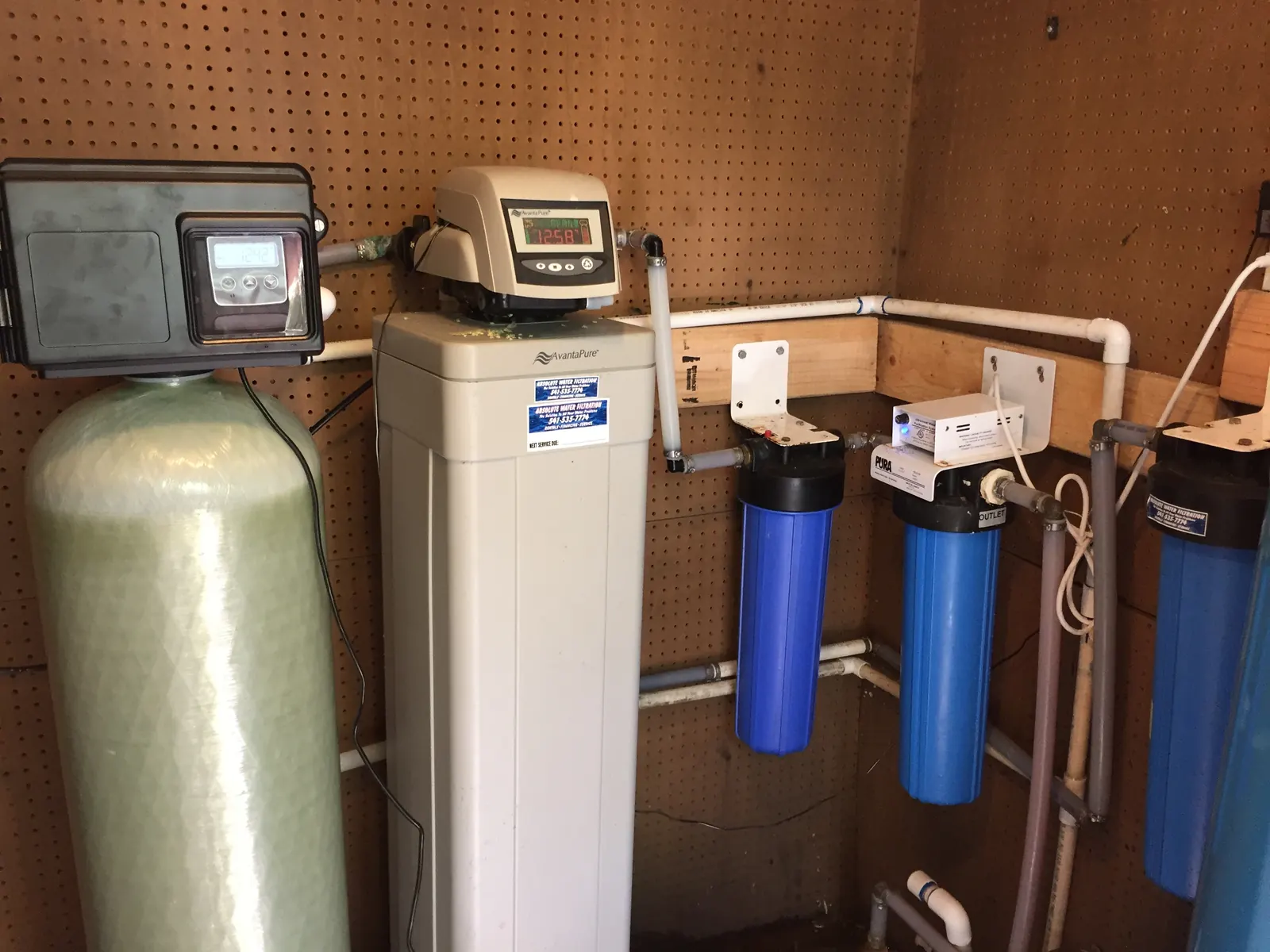
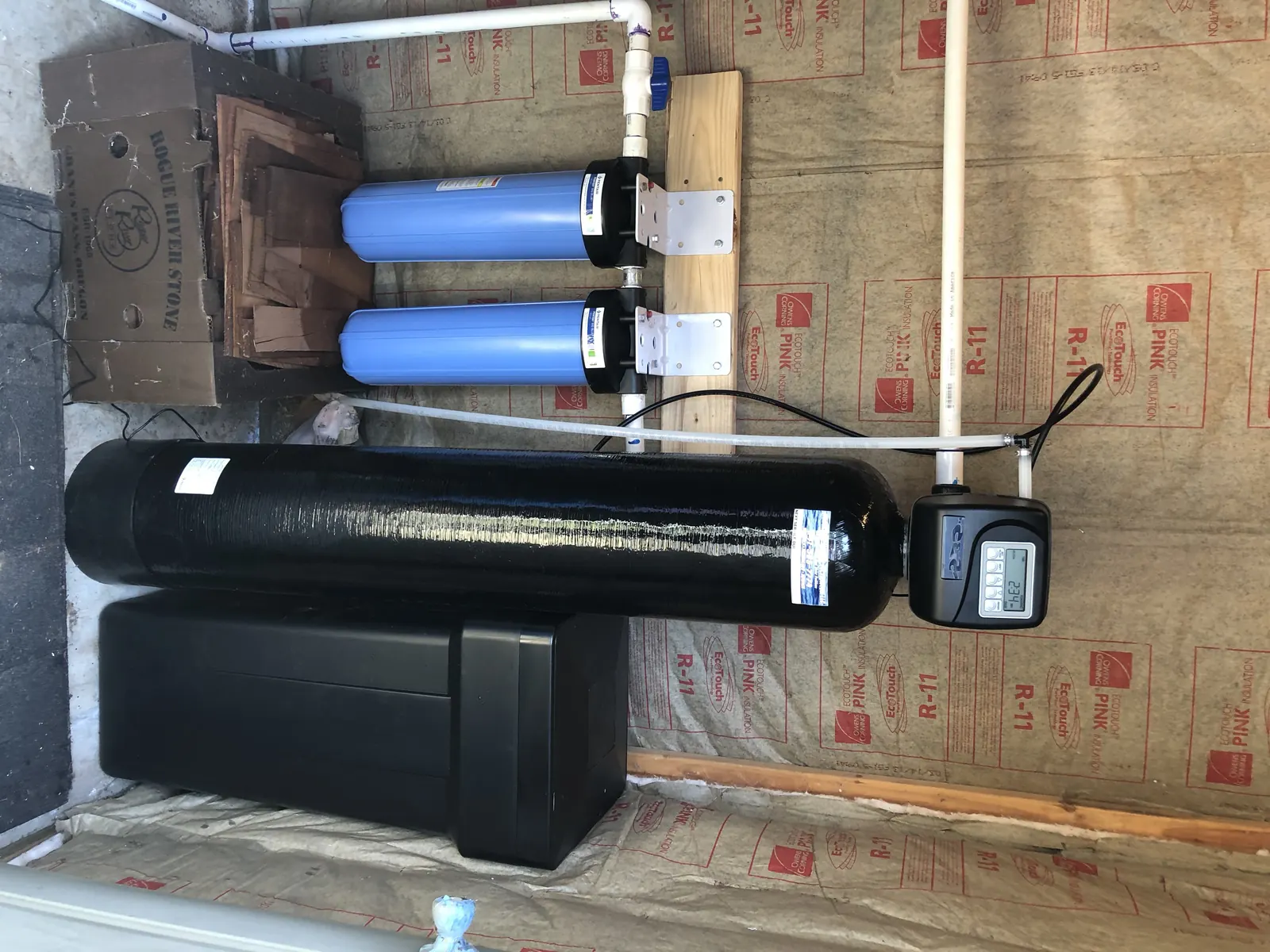
Symptoms we see most often
- White scale on glassware and fixtures
- Hardness above 7 gpg on a lab test
- Short water heater life, recurring element swaps
- Stiff laundry and soap that won't lather
Every water softeners job
- Lab hardness test plus iron / manganese check
- Correctly sized resin and brine tank
- Metered demand-based valve
- Bypass install and scheduled valve service
Special considerations by city
Every city in our service area has its own water chemistry, source, and history. Pick your city for the specific numbers, regulations, and recommendations that shape how water softeners should be configured at your address.
Eight cities served across the Rogue and Klamath basins. Tap a row to expand.
Medford
Medford's Medford Water supply is 1.4-2.4 gpg, "moderately soft" by the utility's own classification (Medford Water Hardness FAQ). A traditional softener in-city is rarely worth the salt.
Outside the Medford Water footprint — East Medford wells toward Agate Desert, or out toward Shady Cove — well water can be substantially harder and iron-bearing; those need proper testing and correct-sized equipment.
Ashland
Ashland does not publish a hardness value in its 2023 CCR (Ashland 2023 CCR), and third-party databases mark it as "n/a" because the utility doesn't report it. Reeder Reservoir is snowmelt off granitic/metamorphic bedrock — very soft water, consistent with Oregon averages of 25-29 mg/L (DROP — Oregon hardness).
Ashland's unique wrinkle is that the TAP intertie brings in Medford Water's supply in drought summers (regularly since 2021) — slightly more mineralized than Ashland Creek snowmelt (Ashland Chronicle — TAP Begin). Residents sometimes notice the taste/feel change; a softener is rarely the right answer here, but a salt-free conditioner can be.
Central Point
Central Point is on Medford Water — Big Butte Springs at 40.1 ppm (2.3 gpg), Rogue River at 30.8 ppm (1.8 gpg) (Medford Water 2024 Water Quality Analyses). Softening city water in Central Point almost never has an ROI case.
The right conversation is for rural Agate Desert wells, where hardness and iron/manganese tend to co-occur.
Eagle Point
Eagle Point's water comes from Medford Water: 1.4-2.4 grains per gallon (25-40 mg/L) — well below the 3.5 gpg "soft" threshold (Medford Water Hardness FAQ). For the average Eagle Point home on city water, a softener is unnecessary.
The exception is rural properties on private wells in the Agate Desert or volcanic bedrock, which can run significantly harder and often have co-occurring iron and manganese — those need a proper water panel before any softener is sized.
Jacksonville
Jacksonville buys from Medford Water — 1.4-2.4 gpg, classified moderately soft (Medford Water FAQ). Ion-exchange softening in town is mostly cosmetic.
Private wells in the foothills and along the Applegate can be considerably harder; that's a well-specific sizing call.
Talent
Talent is Medford Water, 1.4-2.4 gpg, moderately soft (City of Talent; Medford Water FAQ). There's no scale problem on city water.
Rural Talent wells do vary, and wells in valley alluvium are sometimes harder — a pre-install test is the responsible step.
White City
White City's Medford Water customers are on the same 1.4-2.4 gpg supply — no softener needed.
White City wells have no published hardness dataset; any softener decision there depends entirely on the individual well's test results.
Phoenix
Phoenix is on Medford Water — 1.4-2.4 grains per gallon, classified moderately soft (Medford Water Hardness FAQ). A traditional softener in town has no scale-control case.
Rural wells south and east of Phoenix can be considerably harder; that's a well-by-well sizing call after a lab hardness, iron, and manganese panel.
Shady Cove
No published hardness data exists for Shady Cove's small public systems or for the surrounding private-well universe — hardness in Western Cascades volcanic-aquifer wells varies widely, often appearing alongside iron and manganese.
A softener decision in Shady Cove always starts with a lab panel: hardness in grains per gallon, iron in mg/L, and manganese in mg/L. Iron above ~0.3 mg/L fouls standard softener resin and changes the sizing or requires a pretreatment iron filter.
Gold Hill
No published hardness data exists for Gold Hill's small public Rogue River system. Surface-water hardness is moderate-to-soft most of the year. For rural wells in the foothills and Sams Valley direction, hardness varies widely — wells that pull from gravels and alluvium can be considerably harder than the surface water.
A softener decision starts with a lab hardness, iron, and manganese panel.
Grants Pass
Grants Pass Water (Rogue River source) is generally moderately soft — softener ROI on city water in town is weak. Rural wells in the foothills and outlying valleys can be considerably harder, and many also carry iron and manganese, which fouls standard softener resin.
Softener decisions in Grants Pass start with a lab hardness, iron, and manganese panel before any equipment is sized.
Klamath Falls
Klamath Falls is the only city in this list where hardness varies substantially by neighborhood, because the city draws from 11 wells with very different chemistry. From the 2024 CCR (Klamath Falls 2024 CCR):
- Conger Wellfield — 50 mg/L (~2.9 gpg)
- Debbie — 66 mg/L (~3.9 gpg)
- Fremont — 74 mg/L (~4.3 gpg)
- Hilyard — 76 mg/L (~4.4 gpg)
- Wocus — 66 mg/L (~3.9 gpg)
- Balsam — 130 mg/L (~7.6 gpg)
- Homedale — 140 mg/L (~8.2 gpg)
Homes served primarily by the Balsam or Homedale wells see genuinely hard water (7+ gpg) while homes nearer Conger Well Field are soft. A softener is a real conversation for the harder zones; we qualify by neighborhood and hardness test.
Three visits. Done right.
- 01
Free on-site test
We test your tap or well for the contaminants that actually apply to your city and geology — not a generic 14-panel sticker.
- 02
Right-sized install
Flow rates, household size, and symptom priorities decide the system. Sourced from certified NSF manufacturers — never a one-size pitch.
- 03
Annual checkup
We come back once a year to swap media, retest the water, and catch anything small before it grows.