Whole-home water filters
Catch chlorine, DBPs, and sediment before they reach a faucet.
How it works.
A point-of-entry filter protects every tap and shower in the house. We size sediment, GAC, catalytic carbon, or KDF-based systems to your tap test and your household's peak flow — and we stock NSF/ANSI 42, 53, 401, and 372 certified media.
Different media target different problems. Sediment cartridges (5-50 micron) capture sand, rust flakes, and silt. Granular activated carbon reduces chlorine, taste, odor, and many VOCs. Carbon block filters finer and — when NSF/ANSI 53 certified — reduces lead, cysts, and selected PFAS. KDF (copper-zinc) reduces chlorine and heavy metals, and inhibits bacterial growth in the media bed.
Filters come in two forms: point-of-entry / whole-house at the water main, typically for chlorine, sediment, and taste; and point-of-use at a single tap when the goal is drinking-quality water at that fixture. Look for NSF/ANSI certifications 42 (aesthetic), 53 (health), 401 (emerging contaminants), 58 (RO), and 372 (lead-free materials).
We test your water at the tap, look at the most recent Consumer Confidence Report, and size a filter (or multi-stage system) to the flow rate and peak demand of your house.
From recent jobs.
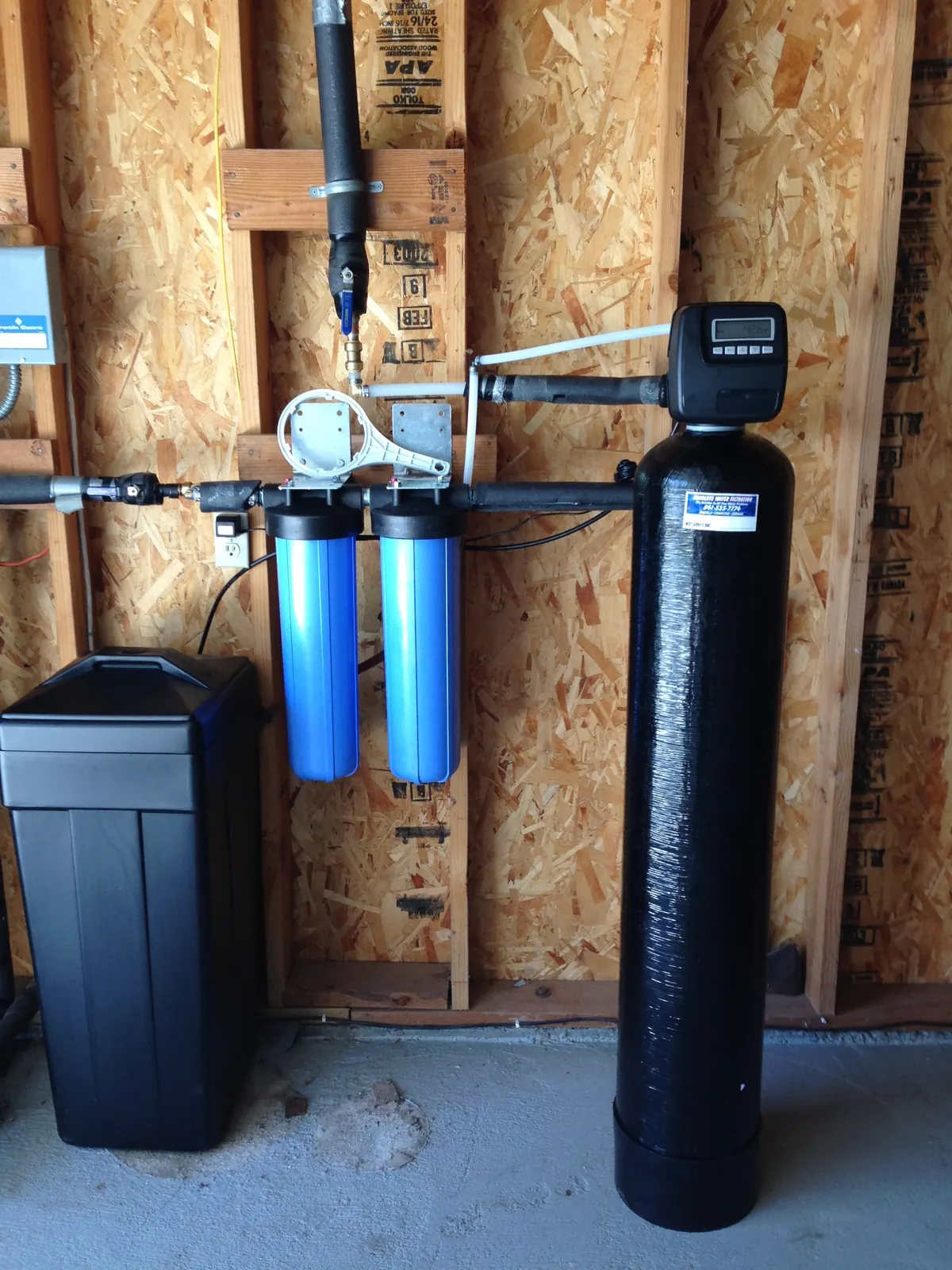
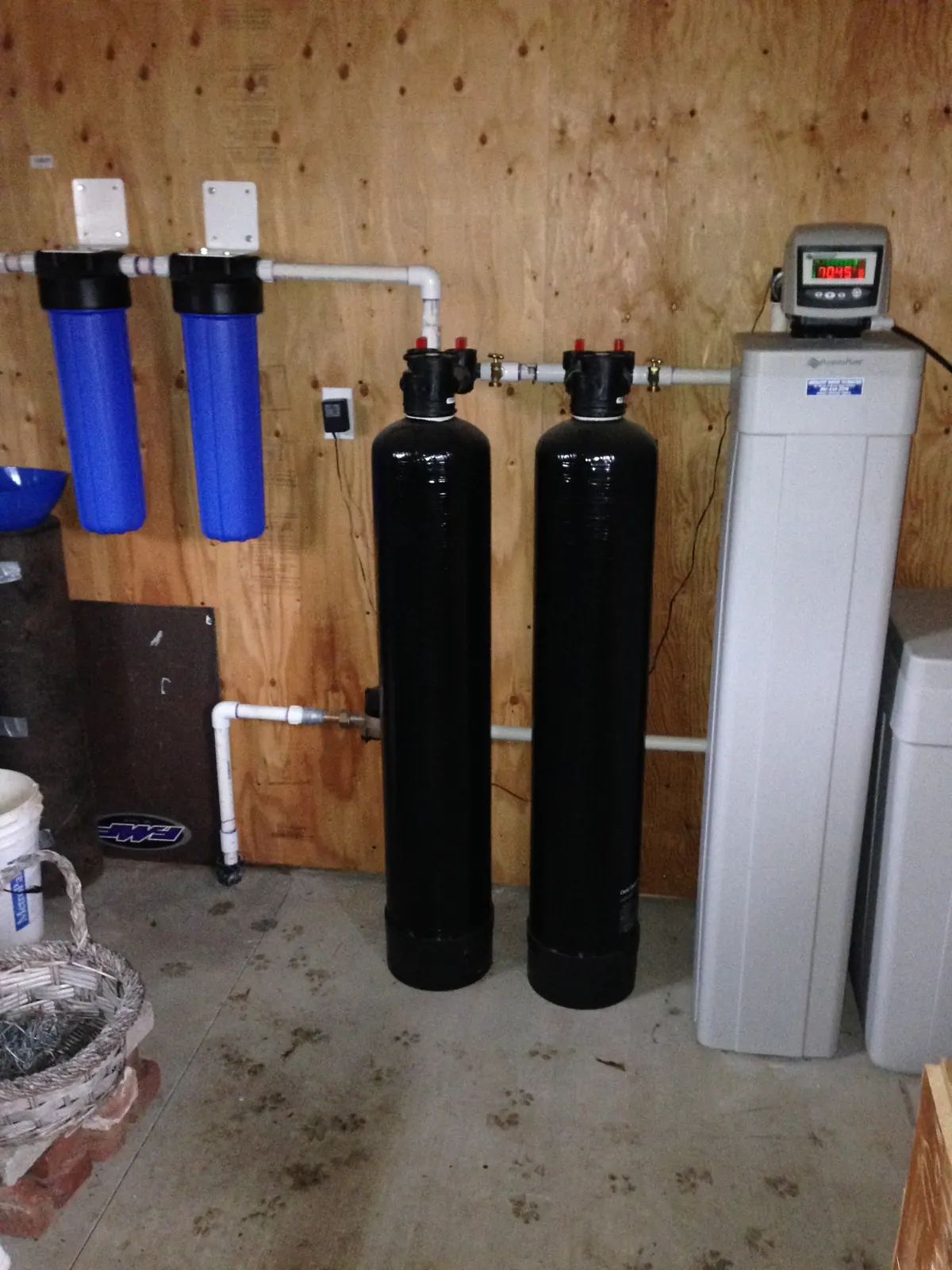
Symptoms we see most often
- Chlorine or pool-water smell at the tap
- Sediment or rust flakes in fixture screens
- Elevated TTHMs or HAA5 on your CCR
- Dry skin or dulled hair after showers
Every whole-home water filters job
- Sediment prefilter sized to service flow
- Activated or catalytic carbon stage
- NSF-certified media and housings
- Scheduled cartridge and media service
Special considerations by city
Every city in our service area has its own water chemistry, source, and history. Pick your city for the specific numbers, regulations, and recommendations that shape how whole-home water filters should be configured at your address.
Eight cities served across the Rogue and Klamath basins. Tap a row to expand.
Medford
Medford's water is clean and soft (Big Butte Springs plus Rogue River), but the EWG database still flags TTHM 13.9 ppb (92x EWG guideline), HAA5 11.2 ppb (112x), chromium-6 0.159 ppb (7.9x), and HAA9 6.03 ppb (100x) (EWG — Medford).
DBP levels trend up in summer when Medford Water switches to Rogue River source — higher dissolved organics mean more DBP precursors (Medford Water FAQs). A whole-home carbon filter is an easy fit, with an under-sink drinking filter for kitchens that want DBPs cut the most.
Ashland
Ashland's raw Reeder Reservoir water has a total organic carbon measurement up to 6.16 ppm (2023 CCR) — the highest of any city in this list, because Reeder is a surface snowmelt source on a forested granitic watershed.
High raw TOC is the reason Ashland's finished water averages TTHM 24.36 ppb and HAA5 19.24 ppb (both legal; EWG flags them at 172x and 203x guideline). The existing Ashland treatment plant, built 1948, has "limited treatment capacity... for algal toxins" per the city (Ashland WTP Background); a replacement plant with ozone is still in design. A household-level carbon filter bridges that gap.
Central Point
Central Point's tap-end TTHM running average (23.3 ppb) is higher than the number measured entering the distribution system (17.1 ppb) because chlorinated DBPs keep forming as water moves through the mains (Medford Water 2024 CCR).
Point-of-use carbon filtration is the most efficient way to push that number back down where you actually drink it. Some of the city's water infrastructure dates to the early 1900s (City of Central Point — Water), another reason for a final polish at the tap.
Eagle Point
Eagle Point buys 100% of its water from Medford Water and receives about 70% Big Butte Springs / 30% Rogue River in a typical year (Medford Water 2024 Water Quality Analyses). The city's distribution-system chlorine residual averaged 0.5 ppm in 2024 (2024 CCR).
The EWG database flags Eagle Point for TTHMs 21.3 ppb, HAA5 19.2 ppb, HAA9 6.03 ppb, chromium-6 0.159 ppb, and chlorate 202.3 ppb — all below federal MCLs but each exceeding EWG's stricter health guidelines by 7x-192x (EWG — Eagle Point). A certified carbon block (NSF/ANSI 42 + 53) directly addresses every one of those.
Jacksonville
Jacksonville is a Medford Water wholesale customer and sits near the far end of the distribution system, which matters because disinfection byproducts keep forming as chlorinated water sits in pipes. Jacksonville's 2024 CCR reports HAA5 at 27.4 ppb, among the highest in Medford's service area.
The longer-term EWG profile shows TTHM at 21.7 ppb (144x the EWG guideline) (2024 CCR; EWG — Jacksonville). Both values are legal, but a whole-home catalytic carbon filter is the most direct way to cut them at every tap and shower.
Talent
Talent's municipal water arrives from Medford Water through the TAP (Talent-Ashland-Phoenix) transmission main (City of Talent — Water Distribution). A carbon filter covers the free-chlorine residual and the same MWC DBP profile.
The specific reason to install filtration in Talent is the Almeda Fire (Sept 8, 2020): Oregon Drinking Water Services records 51-52 post-fire VOC samples in Talent between 2020 and March 2022, with 18 detections and 3 MCL exceedances (Oregon DWS Post-Wildfire VOC Sampling). Secondary reporting of the AWWA Toth 2024 paper puts peak benzene at 76.4 µg/L — 15x the federal 5 ppb MCL (AWWA — Toth 2024). Rebuilt homes, and surviving homes on blocks where neighbors burned, should have whole-home carbon plus a point-of-use RO at the kitchen.
White City
White City's Medford Water supply is chlorinated and measured DBPs match the rest of the MWC service area — a carbon filter handles that cleanly. The bigger filter story in White City is for well owners.
More than 25 DEQ cleanup sites are documented within the community, including Vickers/Eaton with ongoing off-site TCE/PCE groundwater plume investigation (DEQ ECSI Site 2281) and Balteau Standard with dichloroethylenes at 27,000 ppb and 1,1,1-trichloroethane at 13,000 ppb in groundwater (DEQ ECSI Site 533). Wells anywhere near Table Rock Rd., Pacific Ave., or Antelope Rd. should not rely on simple sediment or carbon alone.
Phoenix
Phoenix is a Medford Water wholesale customer fed through the TAP transmission main shared with Talent and Ashland (Medford Water — About). The Phoenix tap-end profile in the 2024 CCR runs TTHM 7.1 ppb and HAA5 3.4 ppb, lower than Talent or Jacksonville at the distribution tail (Medford Water 2024 CCR).
Distribution chlorine residual averaged 0.6 ppm in 2024. A standard whole-home carbon filter cuts chlorine and the residual DBPs cleanly. The bigger filter case in Phoenix is the post-Almeda VOC concern in the rebuilt blocks south of Highway 99.
Shady Cove
Shady Cove has limited municipal water — most residents are on private wells or small public systems serving manufactured-home parks and subdivisions. For homes that do receive small-system chlorinated supply, a sediment plus activated-carbon stage handles taste and residual disinfectant.
The bigger filter conversation in Shady Cove is for well owners. The same Western Cascades volcanic bedrock that drives the regional arsenic signal also produces iron, manganese, and turbidity carryover during spring runoff. A properly sized whole-home stack typically pairs sediment plus catalytic carbon with an iron/manganese stage when needed (Oregon OHA — Iron and Manganese in Groundwater).
Gold Hill
Gold Hill operates a small Rogue River-sourced public system. The treatment train and DBP-formation pattern are typical of small surface-water systems: sediment carryover during spring runoff, free-chlorine residual, and DBPs forming through distribution. A whole-home sediment plus activated-carbon stage cuts the chlorine, the visible particulates, and the residual DBPs.
For rural Gold Hill households on private wells in gold-belt bedrock, the filter conversation is different — and is dominated by arsenic. See the Gold Hill arsenic page.
Grants Pass
Grants Pass is the population center of Josephine County and draws its city water from the Rogue River through Grants Pass Water. The treatment plant runs conventional filtration plus chlorination — a profile similar to other Rogue Basin surface-water utilities. A whole-home carbon system cuts chlorine residual, residual DBPs forming in distribution, and any summer-organic-load taste change.
For Josephine County rural households on private wells, a different stack applies — see the Grants Pass well services page.
Klamath Falls
Klamath Falls runs on 100% groundwater from 11 city wells and disinfects with chlorine only (not chloramine), so standard activated carbon works well. The 2024 CCR reports TTHM and HAA5 as Not Detected (2024 CCR).
The filter focus in Klamath Falls is different from Rogue Valley cities: it's arsenic (up to 7.71 ppb, 1,123x EWG's health guideline), chromium-6 (0.170 ppb, 8.5x guideline), and PFOS detected at the Balsam Well at 4.7-9.5 ppt — above the 2024 EPA MCL of 4.0 ppt that the city must meet by 2029 (EWG — Klamath Falls). Standard carbon is useful for taste and odor, but the real value is a multi-stage system with a specialty arsenic stage.
Three visits. Done right.
- 01
Free on-site test
We test your tap or well for the contaminants that actually apply to your city and geology — not a generic 14-panel sticker.
- 02
Right-sized install
Flow rates, household size, and symptom priorities decide the system. Sourced from certified NSF manufacturers — never a one-size pitch.
- 03
Annual checkup
We come back once a year to swap media, retest the water, and catch anything small before it grows.