How it works.
Free chlorine is removed efficiently by standard granular activated carbon. Chloramine — chlorine plus ammonia — is more persistent and needs catalytic activated carbon. We check your utility's CCR for which disinfectant they use and size contact time and media to your service flow.
Chlorine is how public water stays safely disinfected from the treatment plant to your kitchen sink — and it works. But chlorine residual at the tap (typically 0.5-4 mg/L) has real household downsides: taste and odor, dry skin, itchy eyes, hair dulling, reaction with household organic matter to form DBPs, and damage to sensitive plants, aquariums, and rubber seals.
Not all residual disinfectants are the same. Free chlorine (sodium hypochlorite) is removed efficiently by standard granular activated carbon. Chloramine (chlorine plus ammonia) is more persistent and slower to react with GAC; effective removal requires catalytic activated carbon or longer contact time. Knowing which one your utility uses matters before you buy a filter — your CCR reports it.
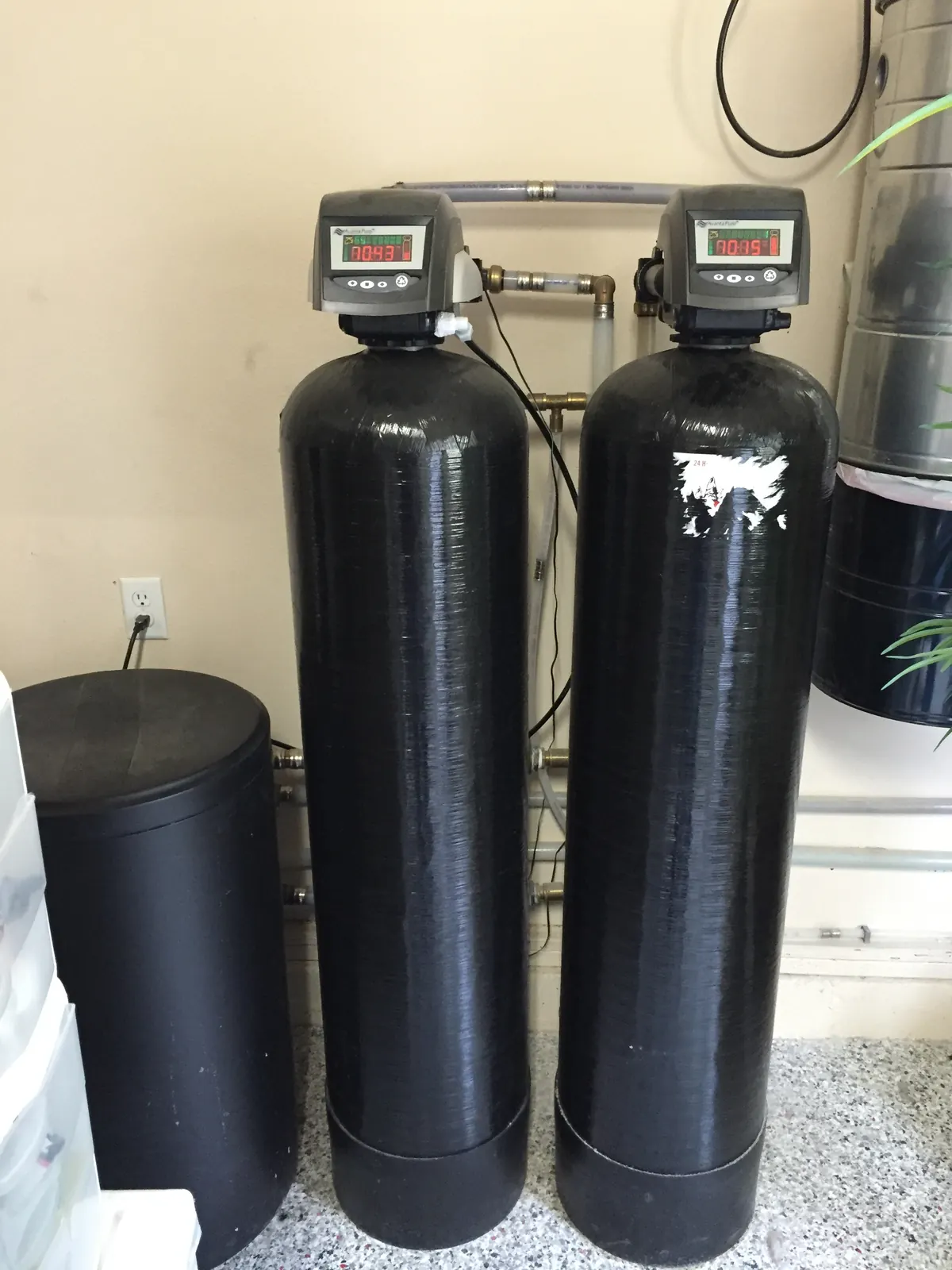
Options: a point-of-use carbon-block or under-sink cartridge, an RO with carbon pre/postfilter, a whole-home 1.5-2.5 cu ft catalytic carbon tank, or a shower filter. We size for your home's service flow and required contact time and install with a bypass.
From a recent job.
Symptoms we see most often
- Chlorine or pool-water taste at the tap
- Hair dulling and itchy skin after showers
- Pets refusing tap water
- Rubber gaskets and seals degrading
Every chlorine removal job
- Standard GAC or catalytic carbon, matched to disinfectant
- Backwashing valve, bypass install
- Shower filter options for bathing
- Scheduled media replacement
Special considerations by city
Every city in our service area has its own water chemistry, source, and history. Pick your city for the specific numbers, regulations, and recommendations that shape how chlorine removal should be configured at your address.
Eight cities served across the Rogue and Klamath basins. Tap a row to expand.
Medford
Medford's Medford Water uses sodium hypochlorite (free chlorine); the system does not use chloramine (Medford Water FAQs).
Entry-point residuals in 2024: 0.6 ppm at Big Butte Springs, 0.9 ppm at the Duff Rogue River plant (Medford Water 2024 Water Quality Analyses). Standard activated carbon — under-sink carbon blocks, point-of-entry carbon tanks, or shower filters — all work without needing the more-expensive catalytic grade.
Ashland
Ashland's treatment-plant chlorine residual in 2023 ranged 0.10 to 1.57 ppm with an average of 0.70 ppm — the highest peak residual in this list (2023 CCR). The disinfectant is sodium hypochlorite (free chlorine). Standard GAC handles it.
Because Ashland's source carries elevated total organic carbon (up to 6.16 ppm raw), chlorine reacts with the organics to form more DBPs than in the spring-fed Medford Water cities — a whole-home carbon that removes chlorine earlier in the plumbing tree also reduces ongoing DBP formation in your own pipes.
Central Point
Central Point distribution chlorine residual (2024): 0.4 ppm average, range 0.1-0.8 ppm, free chlorine (Medford Water 2024 CCR).
GAC removes it cleanly. No chloramine anywhere on Medford Water's system.
Eagle Point
Eagle Point (Medford Water) uses free chlorine (sodium hypochlorite), not chloramine (Medford Water FAQs).
Distribution-system yearly average in 2024 was 0.5 ppm, range 0.2-0.8 ppm (2024 CCR). Standard GAC works — no need for chloramine-rated catalytic carbon, which costs more.
Jacksonville
Jacksonville is Medford Water: free chlorine, not chloramine, distribution residual 0.4 ppm average, range 0.1-0.6 ppm (2024 CCR).
Because Jacksonville sits at the end of the distribution system, the DBP load in the pipe is elevated (HAA5 27.4 ppb) — a whole-home carbon filter that removes chlorine also takes a meaningful bite out of the DBPs forming along with it.
Talent
Talent is Medford Water: free chlorine via the TAP transmission main (City of Talent — Water Distribution). GAC carbon handles chlorine removal.
The more interesting post-Almeda issue in Talent is residual VOC concern from heat-damaged service lines, which needs RO or a carbon system with more contact time.
White City
White City's Medford Water-served homes see the same free-chlorine residual. GAC removes it.
For well homes, chlorine isn't the main concern — see the Reverse Osmosis and Well Water Services pages.
Phoenix
Phoenix is Medford Water — free chlorine (sodium hypochlorite), not chloramine (Medford Water FAQs). Distribution residual averaged 0.6 ppm in 2024, range 0.3-0.8 ppm (Medford Water 2024 CCR).
Standard granular activated carbon handles it — no need for the more expensive catalytic-carbon grade required for chloramine systems.
Shady Cove
For Shady Cove residents on small chlorinated public systems, standard granular activated carbon removes free chlorine cleanly — the disinfection-byproduct concern in surface-water systems is also reduced.
Most Shady Cove households are on private wells with no chlorine residual at all. For those wells, the disinfection question is the opposite — many wells should have UV disinfection or periodic shock chlorination, not chlorine removal.
Gold Hill
Gold Hill's small public system uses free chlorine (typical for surface-water utilities of this size) — standard granular activated carbon removes it cleanly at the household level.
For rural well households with no chlorine residual at all, the disinfection question is the opposite: many wells should have UV disinfection or periodic shock chlorination after a positive coliform test.
Grants Pass
Grants Pass Water uses free chlorine for distribution disinfection — standard granular activated carbon at point-of-entry or under-sink removes it cleanly. Chloramine-rated catalytic media is not required for a free-chlorine system.
For households where the chlorine taste is mainly a kitchen-tap and shower complaint, a point-of-use carbon block plus a shower filter is often sufficient — full whole-home carbon is the right call when the goal is also DBP reduction at every fixture.
Klamath Falls
Klamath Falls uses chlorine only on 100% groundwater from city wells; the 2024 CCR measured residuals of 0.20 to 0.26 mg/L — among the lowest in this list.
The city's own CCR language is clean on this point: "we only treat the water with a single common additive, chlorine" (2024 CCR). Standard GAC carbon or carbon-block is sufficient for chlorine removal.
Three visits. Done right.
- 01
Free on-site test
We test your tap or well for the contaminants that actually apply to your city and geology — not a generic 14-panel sticker.
- 02
Right-sized install
Flow rates, household size, and symptom priorities decide the system. Sourced from certified NSF manufacturers — never a one-size pitch.
- 03
Annual checkup
We come back once a year to swap media, retest the water, and catch anything small before it grows.