Reverse osmosis
95-99% rejection of dissolved solids at the kitchen tap.
How it works.
A point-of-use RO rejects arsenic, nitrate, fluoride, chromium-6, PFAS, lead, and trihalomethanes at 95-99% — all from one under-sink unit. We size, install, sanitize, and run the feed-water test first so the membrane isn't ruined by iron, hardness, or chlorine you didn't know about.
Reverse osmosis forces water through a semi-permeable membrane under pressure. The membrane's pores are about 0.0001 micron — small enough to reject almost every dissolved solid your water carries. An RO system removes 95-99% of lead, arsenic, nitrate, fluoride, chromium-6, sodium, sulfate, PFAS, many pharmaceuticals and pesticides, bacteria, viruses, and (with pre/post carbon) chlorine.
What RO does not remove well: dissolved gases like hydrogen sulfide and CO2 — these pass through and need separate pretreatment. Most residential installs are point-of-use, a 4- or 5-stage under-sink system at ~50 GPD capacity. Whole-house RO is reserved for homes with unsolvable whole-supply TDS, arsenic, or nitrate issues. Modern tankless units can reach 1:1 recovery instead of the traditional 3-4:1 reject ratio.
RO water is slightly acidic and low in minerals, so many systems add a remineralization cartridge after the membrane for taste and pH. Certified RO systems carry NSF/ANSI 58. We service prefilters annually and replace the membrane every 2-5 years depending on feed-water chemistry.
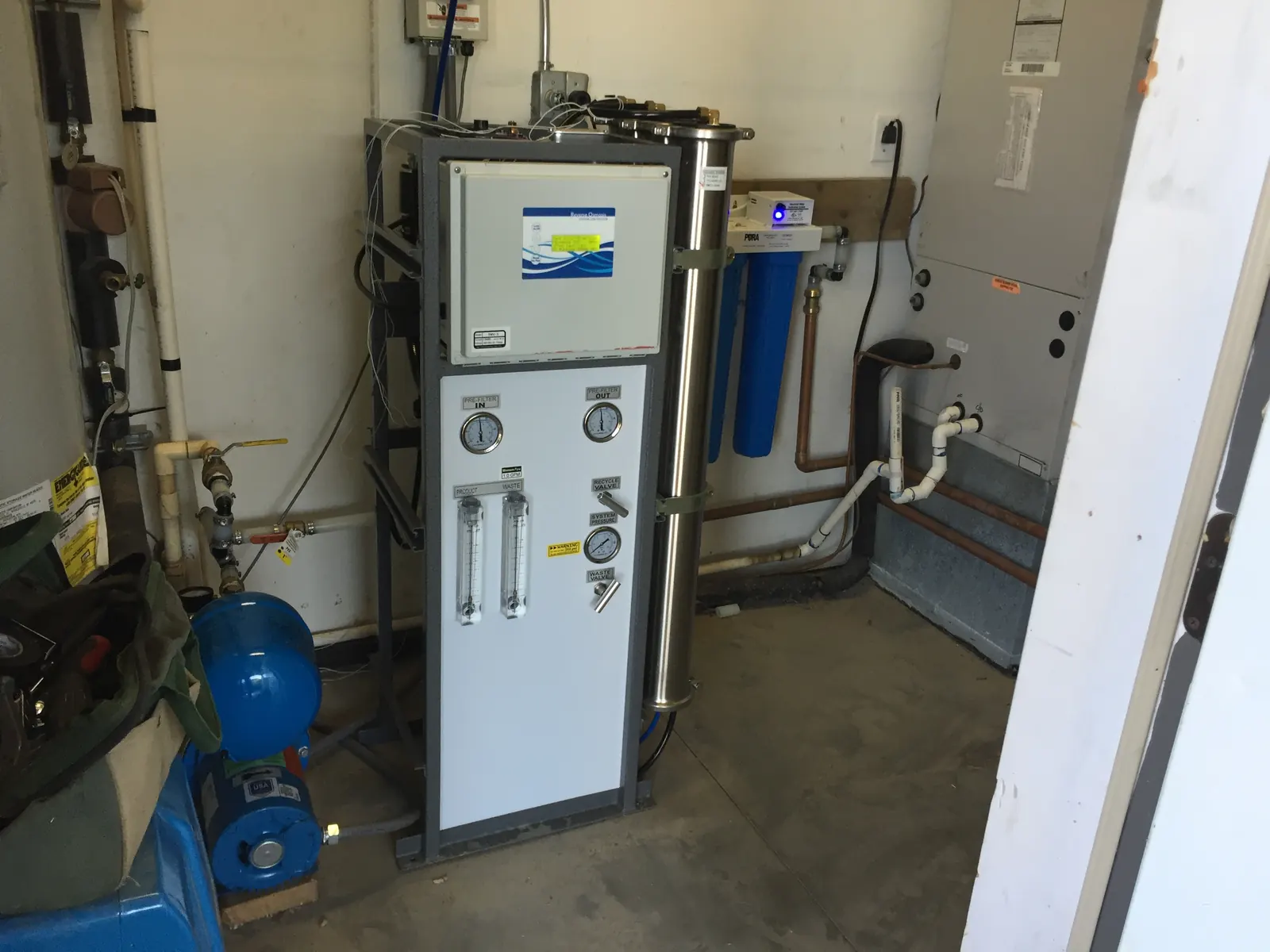
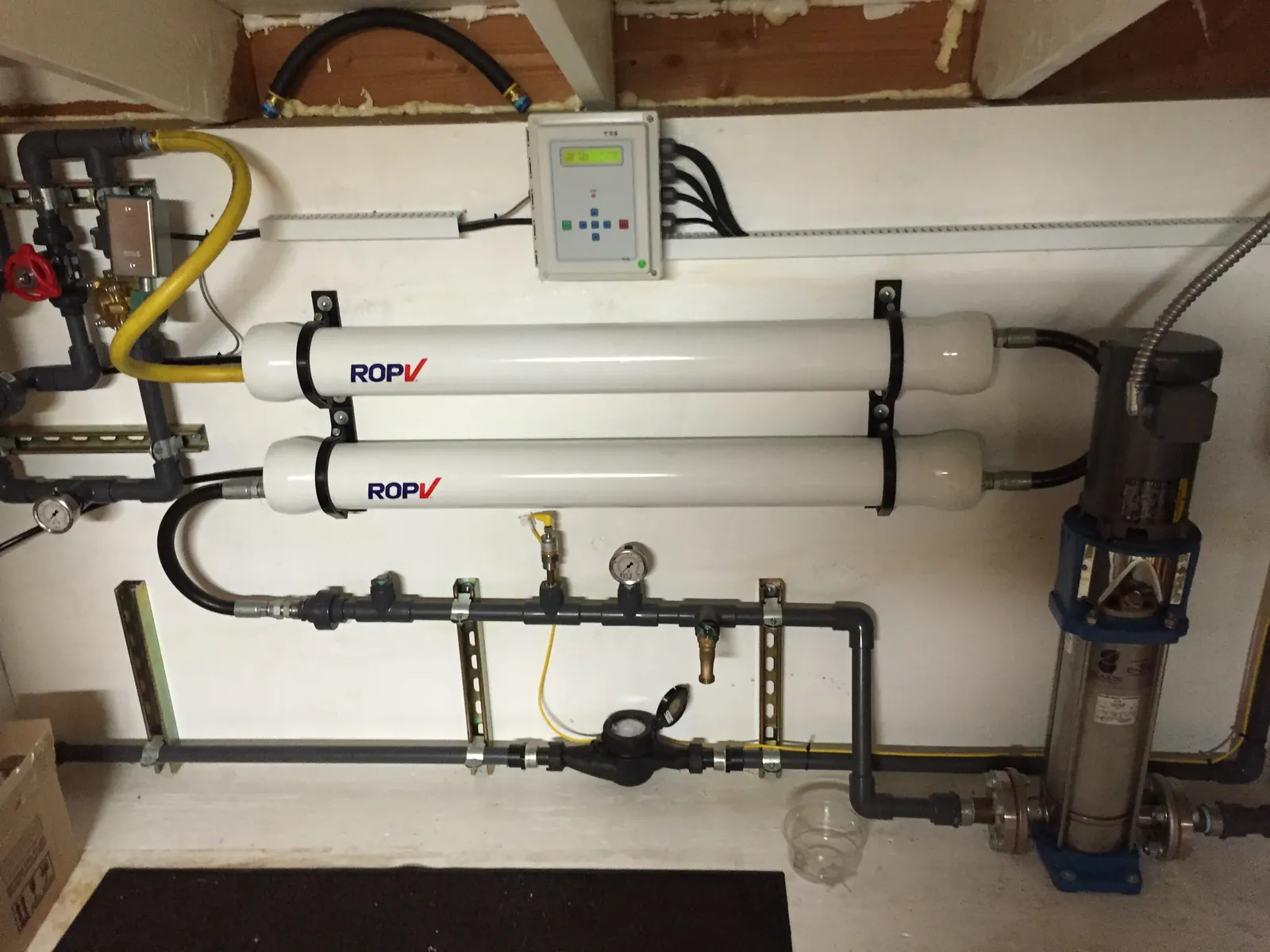
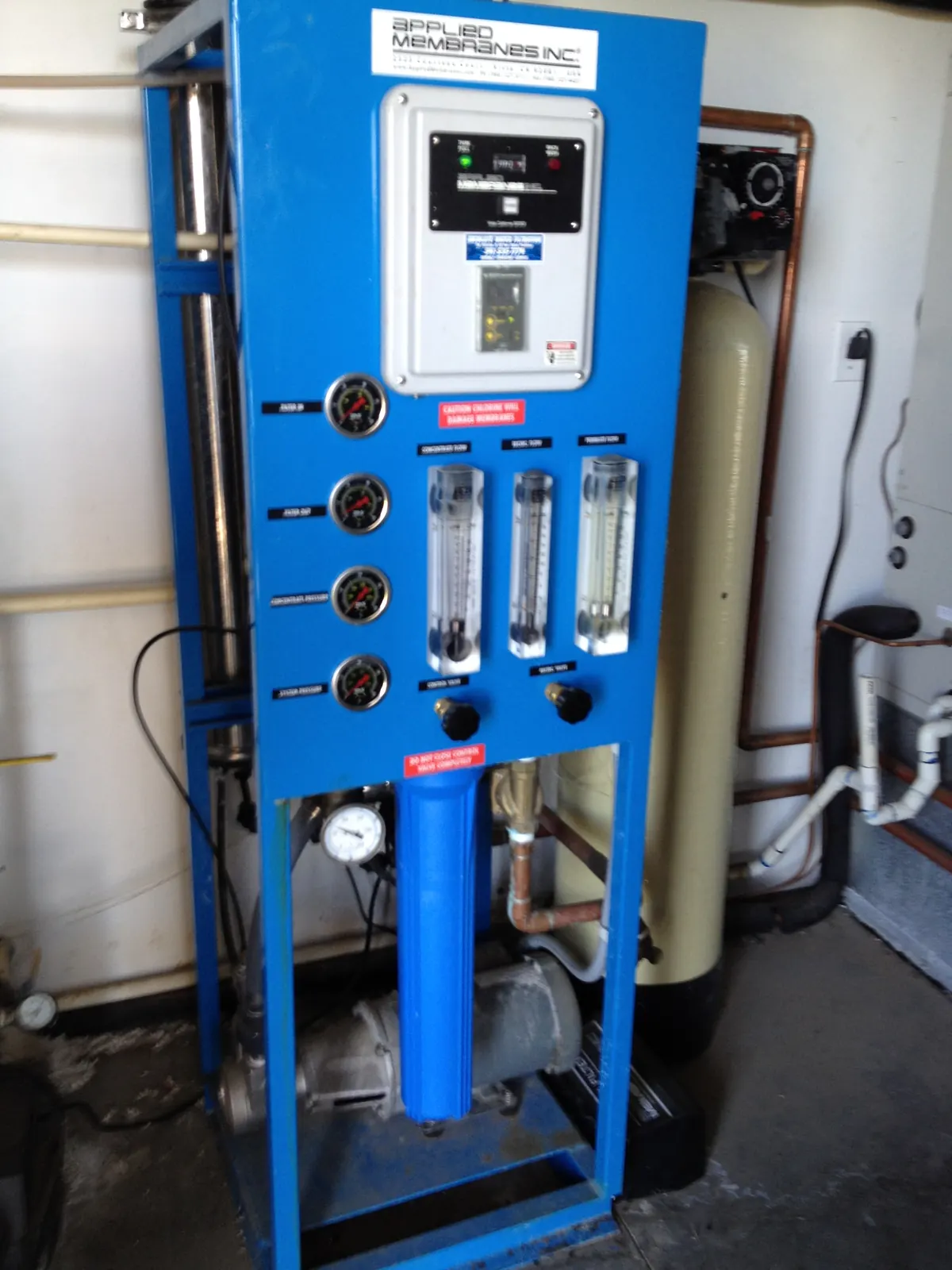
From recent jobs.
Symptoms we see most often
- Buying bottled water for drinking and coffee
- Arsenic, nitrate, or PFAS on your water report
- Chromium-6 or DBPs above EWG guidelines
- Post-wildfire VOC concern in rebuilt area
Every reverse osmosis job
- 4- or 5-stage NSF/ANSI 58 certified system
- Dedicated faucet and ice-maker tee
- Optional remineralization cartridge
- Annual prefilter service, 2-5 year membrane
Special considerations by city
Every city in our service area has its own water chemistry, source, and history. Pick your city for the specific numbers, regulations, and recommendations that shape how reverse osmosis should be configured at your address.
Eight cities served across the Rogue and Klamath basins. Tap a row to expand.
Medford
Medford's finished water is legally compliant, so RO here is a premium drinking-water choice rather than a fix for a specific MCL problem. The EWG-flagged contaminants RO handles: chromium-6 0.159 ppb (7.9x guideline), TTHM 13.9 ppb, HAA5 11.2 ppb, chlorate 202.3 ppb (EWG — Medford).
In summer months (May-September) when Medford Water shifts toward Rogue River source, organics and DBP potential rise (Medford Water FAQs) — RO smooths out that seasonal taste change.
Ashland
Ashland's water treatment plant was built in 1948 and the city itself states it has "limited treatment capacity for... algal toxins" (Ashland WTP Background); the replacement plant with ozone treatment is in design with construction around 2026.
Until it's online, an RO is household-level insurance against: TTHMs (24.36 ppb avg, EWG 172x guideline), HAA5 (19.24 ppb, 203x), HAA9 (EWG 426x), hexavalent chromium (0.0505 ppb, 2.5x), Cryptosporidium (standard treatment is filtration plus chlorine only — oocysts resist chlorine), and any post-wildfire turbidity/metals carryover if the watershed ever has a bad fire year (2023 CCR; EWG — Ashland). It also smooths out the noticeable taste change when Ashland switches to TAP water in drought summers.
Central Point
On Central Point's distribution system, TTHM averages 23.3 ppb at the tap vs 17.1 ppb entering distribution — DBPs continue to form between Medford Water's plant and your kitchen (Medford Water 2024 CCR). An under-sink RO is the most efficient way to cut what you actually drink.
For Agate Desert rural parcels on wells, RO covers arsenic + nitrate + naturally occurring boron and fluoride in a single under-sink unit.
Eagle Point
Eagle Point has no MCL-level contamination to remove, but an under-sink RO hits a list of things EWG flags in the Eagle Point supply: TTHM 21.3 ppb (142x guideline), HAA5 19.2 ppb (192x), HAA9 6.03 ppb (100x), chromium-6 0.159 ppb (7.9x), and chlorate 202.3 ppb (EWG — Eagle Point).
For rural Eagle Point residents on wells, an RO is also the simplest arsenic and nitrate solution if the well tests out.
Jacksonville
Jacksonville sits at the distribution tail of the Medford Water system, so DBPs continue to form in the pipes. Jacksonville's 2024 CCR reports HAA5 at 27.4 ppb (2024 CCR) and the EWG long-trend average for the city is TTHM 21.7 ppb (144x guideline) and HAA5 13.9 ppb (139x) (EWG — Jacksonville).
For any resident on a private well in the Ruch / Kanaka Flats / Applegate / South Stage area, an RO is also the simplest coverage against the regional arsenic profile — one Jacksonville well has tested at 32.1 ppb (3.2x the MCL) (Pure Water Solutions).
Talent
RO is the lead Absolute Water Filtration recommendation for any Talent home rebuilt after the Almeda Fire, or any surviving home on a block where neighbors burned. Oregon DWS records 51-52 post-fire VOC samples in Talent between 2020 and March 2022 — 18 with detections, 3 above the federal MCL (Oregon DWS Post-Wildfire VOC Sampling); secondary reporting of the AWWA Toth 2024 paper puts peak benzene at 76.4 µg/L (15x the 5 ppb MCL) (AWWA).
Boiling does not remove benzene and can actually increase exposure through inhalation (The Conversation — Whelton). A POU RO with carbon prefilters is one of the few household technologies that meaningfully reduces benzene and other VOCs below the MCL.
White City
RO is the highest-priority Absolute Water Filtration service for White City well owners. DEQ documents multiple groundwater contamination plumes directly under the community: Vickers/Eaton (7638 Pacific Ave.) has an ongoing off-site migration investigation of TCE, PCE, DCE, and related solvents (DEQ ECSI Site 2281); Balteau Standard (8001 Table Rock Rd.) had dichloroethylenes at 27,000 ppb and trichloroethanes at 13,000 ppb in groundwater (DEQ ECSI Site 533); Cascade Wood Products (8399 14th St.) has a pentachlorophenol plume up to 25,000 ppb extending west (DEQ ECSI Site 20).
RO with a carbon prefilter is the standard residential treatment for chlorinated solvents and PCP. Any well within roughly a mile of Pacific Ave., Table Rock Rd., or Antelope Rd. should be tested for VOCs — and treated if detected.
Phoenix
Phoenix RO has two strong drivers. First, the standard MWC long-trend EWG flags: TTHM, HAA5, chromium-6, and chlorate above EWG's stricter health guidelines (EWG — Medford) — RO at the kitchen rejects all of them at 95-99%.
Second, post-Almeda VOC concern. Boiling does not remove benzene and can increase exposure through inhalation (The Conversation — Whelton). For any Phoenix home rebuilt after September 2020, or any surviving home on a block that burned, a point-of-use RO with carbon prefilter is the cleanest household-level VOC control.
Shady Cove
RO is the highest-value single product for Shady Cove well households. One under-sink unit handles arsenic (the dominant local risk per OPB 2024 reporting on Rogue Meadows), naturally occurring fluoride, nitrate, and dissolved metals — all in a single 4- or 5-stage system at the kitchen tap.
For wells with elevated arsenic and total dissolved solids, RO is also the simplest defense against any other regional contaminants — chromium-6, naturally occurring boron in some volcanic-aquifer wells, and any agricultural nitrate carryover.
Gold Hill
RO is the highest-value single product for Gold Hill well households. One point-of-use RO addresses the dominant local risk — arsenic at 11.7 ppb on the documented Pure Water Solutions / USGS-referenced well — plus naturally occurring fluoride, nitrate, and any chromium-6 in volcanic-aquifer water (Pure Water Solutions citing USGS).
For city-water customers on Gold Hill's small public Rogue River system, RO at the kitchen is the simplest defense against the standard small-utility surface-water DBP profile.
Grants Pass
RO at the kitchen tap is the standard polish in Grants Pass for two reasons. For city-water households, it removes any residual DBPs forming in the distribution system plus chromium-6, nitrate, and trace PFAS or pharmaceutical residues that survive surface-water treatment.
For rural Grants Pass-area well households, a single under-sink RO is the simplest answer to the documented regional arsenic signal — including the 18.1 ppb Pure Water Solutions / USGS-referenced well — and to any nitrate from agricultural parcels (Pure Water Solutions citing USGS).
Klamath Falls
This is the single most defensible RO market in the list. One point-of-use system addresses every significant Klamath Falls water issue at once: arsenic 2.59-7.71 ppb (1,123x EWG guideline), PFOS 4.7-9.5 ppt at Balsam Well (above the 2024 EPA MCL of 4.0 ppt, compliance required by 2029), naturally occurring fluoride 0.2-0.34 mg/L (geothermal origin), nitrate up to 3.54 mg/L at Balsam Well, chromium-6, TDS, and sulfate/sodium from geothermal-influenced aquifer chemistry (2024 CCR; EWG — Klamath Falls).
If a Klamath Falls home gets only one water-treatment product, this is it.
Three visits. Done right.
- 01
Free on-site test
We test your tap or well for the contaminants that actually apply to your city and geology — not a generic 14-panel sticker.
- 02
Right-sized install
Flow rates, household size, and symptom priorities decide the system. Sourced from certified NSF manufacturers — never a one-size pitch.
- 03
Annual checkup
We come back once a year to swap media, retest the water, and catch anything small before it grows.