City water remediation
Whole-home treatment for chlorine, DBPs, lead, and PFAS.
How it works.
City water is legally compliant but rarely ideal — chlorine residual, TTHMs and HAA5 that keep forming in the pipes, chromium-6, chlorate, and PFAS. We pull your Consumer Confidence Report, test at your tap, and design a carbon + softener + point-of-use RO train for your actual flow.
Even well-regulated city water carries things many households would rather not drink or bathe in: chlorine or chloramine (the taste, the smell, the dry skin); disinfection byproducts (DBPs) — TTHMs and HAA5 formed when chlorine reacts with organic matter, with federal MCLs of 80 and 60 ppb respectively; lead and copper from household plumbing downstream of the meter; hexavalent chromium, chlorate, and HAA9 (no federal MCL but health-based guidelines exist); and PFAS under the EPA's 2024 MCLs.
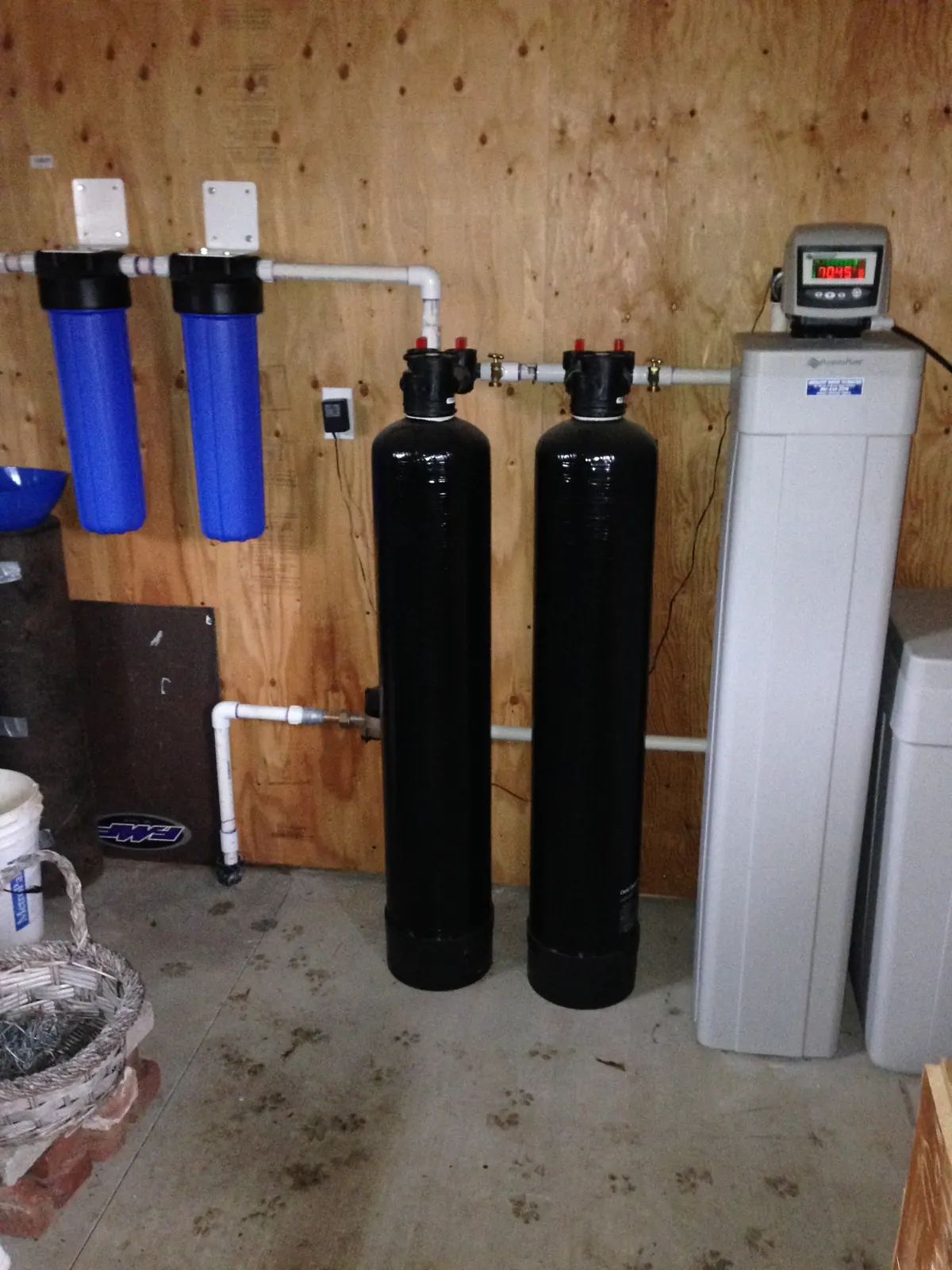
City water remediation is a whole-home approach: a multi-stage system installed where the water enters your house. A typical configuration is a sediment prefilter, a catalytic activated carbon tank (effective against both chlorine and chloramine), an optional softener or salt-free conditioner, and a point-of-use RO at the kitchen. Sizing matters — an under-sized carbon tank breaks through at peak flow.
We pull your city's most recent CCR, test your actual tap water, design a train sized to your peak flow, install with shutoff and bypass valves, and service media on a published schedule — catalytic carbon every 5-10 years, prefilters every 6-12 months, RO membrane every 2-5 years.
From a recent job.
Symptoms we see most often
- Pool-water smell at the shower
- DBPs above EWG health guidelines on CCR
- Old pre-1986 service line — possible lead
- Taste changes when utility switches source in summer
Every city water remediation job
- Sediment prefilter plus catalytic carbon tank
- Optional softener or salt-free conditioner
- Point-of-use RO at the kitchen
- CCR review and tap-side test
Special considerations by city
Every city in our service area has its own water chemistry, source, and history. Pick your city for the specific numbers, regulations, and recommendations that shape how city water remediation should be configured at your address.
Eight cities served across the Rogue and Klamath basins. Tap a row to expand.
Medford
Medford's summer DBP profile is different from its winter profile — when the utility switches from Big Butte Springs to Rogue River source, dissolved organic matter goes up and so does TTHM/HAA5 formation potential (Medford Water FAQs).
Maintenance events and depressurizations on the distribution system can trigger localized boil-water advisories. Whole-home carbon plus sediment filtration adds a layer of protection for events like that on top of daily DBP/chlorine reduction.
Ashland
Ashland has three reasons for city-water remediation that don't apply anywhere else in this list:
- Elevated raw TOC (up to 6.16 ppm at Reeder) driving the highest DBP load among this group — TTHM 24.36 ppb avg and HAA5 19.24 ppb (2023 CCR), both legal but both driven by a surface water treated with conventional direct filtration.
- Reeder turbidity carryover risk. The watershed is steep and granitic; the 1974 flood deposited 130,000 cubic yards of sediment in Reeder in a short period (Resilience.org), and a major watershed fire would do it again.
- Aging plant. The existing Ashland WTP was built in 1948 and the city itself states its treatment capacity is "limited... for algal toxins" (Ashland WTP Background). The replacement plant with ozone is in design but not online.
Whole-home carbon + under-sink RO is household-level insurance on top of Ashland Forest Resiliency and the pending new plant.
Central Point
Central Point has the clearest in-pipe DBP story of the Medford Water wholesale cities: TTHM averages 23.3 ppb at the tap versus 17.1 ppb entering distribution, because DBPs continue to form as water travels through older distribution infrastructure (Medford Water 2024 CCR).
Some of Central Point's water infrastructure dates to the early 1900s (City of Central Point — Water). Whole-home carbon cuts the DBPs; an under-sink RO cuts them further for drinking water.
Eagle Point
Eagle Point's 2024 distribution-system chlorine residual averaged 0.5 ppm, range 0.2-0.8 ppm (2024 CCR). EWG flags TTHM 21.3 ppb (142x guideline), HAA5 19.2 ppb (192x), HAA9 6.03 ppb (100x), chromium-6 0.159 ppb (7.9x), and chlorate 202.3 ppb (EWG — Eagle Point).
All are legal, all are reduced by a whole-home carbon system. Eagle Point also had two positive total-coliform detections in 2024 (triggered a Level 1 investigation; no corrective action required) — not a reason to panic, but a reason not to treat city water as infallible.
Jacksonville
Jacksonville is toward the end of Medford Water's distribution system and sees elevated DBPs as a result: HAA5 27.4 ppb in the 2024 CCR and TTHM 21.7 ppb on EWG's longer-trend profile (2024 CCR; EWG — Jacksonville).
Both are below federal MCLs, both are reduced by whole-home catalytic carbon. The long residence time in the pipes is the reason a point-of-use carbon upgrade makes more difference in Jacksonville than in cities closer to Medford Water's plant.
Talent
Talent is the city where "city water remediation" carries a meaning beyond chlorine and DBPs. The Almeda Fire of September 8, 2020 destroyed approximately one-third of Talent, melted PVC service lines, and triggered an 18-month post-fire VOC sampling program recorded in Oregon DWS data: 51-52 samples, 18 with detections, 3 above the federal MCL (Oregon DWS Post-Wildfire VOC Sampling).
Secondary reporting of the AWWA Toth 2024 paper puts peak benzene at 76.4 µg/L — 15x the federal 5 ppb MCL (AWWA). A whole-home carbon system plus a kitchen-sink RO is the right combination for any rebuilt property or any surviving home where the pre-fire service line might have been heat-damaged.
White City
White City's Medford Water-served homes get the same DBP and chlorine profile as Medford proper — whole-home catalytic carbon handles it.
The harder problem, especially for the part of White City on private wells, is the industrial-solvent legacy: the DEQ ECSI database lists more than 25 documented cleanup sites in and around White City, including groundwater plumes of TCE/PCE (Vickers/Eaton, DEQ ECSI Site 2281) and PCP (Cascade Wood Products, DEQ ECSI Site 20). For well owners, remediation means more than a carbon tank — it means a test-design-install process specific to your well's chemistry.
Phoenix
"City water remediation" in Phoenix carries weight beyond standard chlorine and DBPs. The September 2020 Almeda Fire destroyed thousands of structures across Phoenix and Talent, melted PVC service lines, and triggered a system-wide pressure loss that forced a boil-water advisory issued September 11, 2020 (KOBI5 — Phoenix Boil Water Advisory). Pressure-loss events create bacterial-intrusion risk, and damaged service lines create VOC-leaching risk for years afterward.
The Rogue Valley Council of Governments runs an ongoing Almeda water-quality monitoring program covering Phoenix, Talent, Ashland, and surrounding jurisdictions (RVCOG — Almeda Fire Monitoring). A whole-home carbon system plus a kitchen-sink RO is the right stack for rebuilt properties and surviving homes near burn-impacted blocks.
Shady Cove
The "city water remediation" framing applies less to Shady Cove than to Medford Water-served towns — most residents aren't on a large municipal system. The OPB-documented Rogue Meadows arsenic exceedances illustrate that small water systems can drift out of compliance for years before public attention catches up (OPB 2024).
For households on a small public well, the highest-value response is a household-level point-of-use RO that gives you direct control over what comes out of your kitchen tap — independent of operational decisions made by a system you don't control.
Gold Hill
City-water customers in Gold Hill see the typical small-utility surface-water profile: free-chlorine residual, summer DBP rise during high-organic-load months, and occasional turbidity carryover during spring runoff. A whole-home carbon system handles those cleanly.
The harder local story is the rural ring around the city, where private wells in gold-belt bedrock carry the regional arsenic signal — see the Gold Hill well services page.
Grants Pass
"City water remediation" for Grants Pass means a sediment plus catalytic-carbon stage at the point of entry, sized to peak household flow. Standard fits target chlorine residual, the typical Rogue Basin DBP profile (TTHM and HAA5 forming as chlorinated water sits in mains), and any summer taste change driven by elevated source-water organic load.
An under-sink RO at the kitchen is the standard finisher for households that want the lowest possible drinking-water DBP, chromium-6, and trace contaminant load.
Klamath Falls
Klamath Falls runs a chlorine-only disinfection approach (not chloramine) on 100% groundwater from 11 city wells. Residual is low — 0.20 to 0.26 mg/L — and 2024 CCR TTHM/HAA5 came back Not Detected (2024 CCR). Standard activated carbon works well here (no need for chloramine-rated catalytic carbon).
The specific city-water concerns to design around are arsenic (2.59-7.71 ppb, up to 1,123x EWG guideline), PFOS at Balsam Well (4.7-9.5 ppt — above the new 4.0 ppt EPA MCL), chromium-6, and naturally occurring fluoride from geothermal bedrock. A point-of-use RO handles those, with whole-home carbon for taste and chlorine.
Three visits. Done right.
- 01
Free on-site test
We test your tap or well for the contaminants that actually apply to your city and geology — not a generic 14-panel sticker.
- 02
Right-sized install
Flow rates, household size, and symptom priorities decide the system. Sourced from certified NSF manufacturers — never a one-size pitch.
- 03
Annual checkup
We come back once a year to swap media, retest the water, and catch anything small before it grows.