How it works.
Arsenic is naturally occurring in Southern Oregon's volcanic bedrock and shows up in roughly 44% of tested Jackson County wells. We test for total arsenic plus speciation so the media choice — iron-based adsorptive, anion exchange, or point-of-use RO — actually fits your water.
Long-term exposure to arsenic is linked to skin, bladder, and lung cancer, diabetes, and cardiovascular effects. In 2006 the EPA lowered the Maximum Contaminant Level from 50 to 10 parts per billion for public drinking water. Private wells are not regulated by the EPA — the homeowner is responsible. In Oregon, arsenic testing is only required at real-estate transfer.
Arsenic exists in two forms. Arsenate (As V) is charged and removable by most technologies. Arsenite (As III) is uncharged, harder to capture, and needs oxidation to convert to As(V) first. That's why speciation matters — a test that reports only total arsenic can mislead the treatment choice.
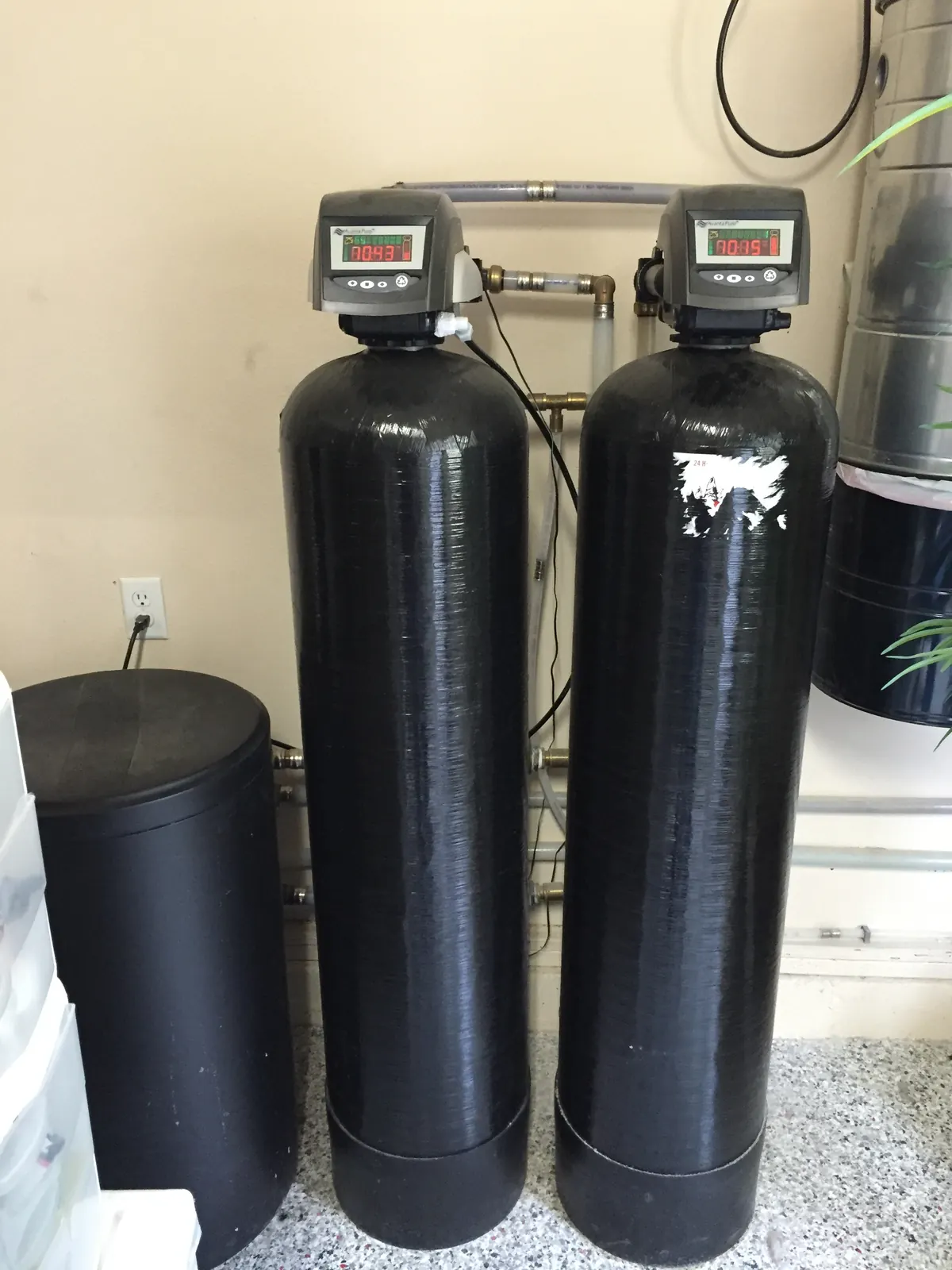
Proven options include reverse osmosis at a single drinking tap (95%+ rejection of arsenate), adsorptive media in a whole-house tank (iron-based Bayoxide E33, GFH, or titanium dioxide), and anion exchange in low-sulfate water. We install both, retest on a schedule, and replace media before breakthrough — typically every 2-5 years.
From a recent job.
Symptoms we see most often
- Well drilled into volcanic or gold-belt bedrock
- Arsenic above 10 ppb on a state or lab test
- Property transfer test decades old
- Neighboring wells with known detections
Every arsenic removal job
- Lab test with As(III) / As(V) speciation
- Adsorptive media or point-of-use RO
- Post-install confirmation retest
- Scheduled media replacement before breakthrough
Special considerations by city
Every city in our service area has its own water chemistry, source, and history. Pick your city for the specific numbers, regulations, and recommendations that shape how arsenic removal should be configured at your address.
Eight cities served across the Rogue and Klamath basins. Tap a row to expand.
Medford
Medford's city water is arsenic-free at both Medford Water sources (EWG — Medford). The arsenic story is in the outlying wells of the Rogue Valley.
Jackson County drinking-water coordinator Tony George told OPB that arsenic in Southern Oregon "isn't an issue that's an overnight fix" and the area has "an increased concentration of arsenic in the geology" (OPB 2024). In July 2024 OPB documented that the Rogue Meadows mobile-home-park public system in nearby Shady Cove exceeded the arsenic MCL in 2020, 2021, and 2023. If you live on a well outside the Medford Water footprint, arsenic testing belongs on your checklist every 3-5 years (OSU Well Water Program).
Ashland
Ashland city water (Reeder Reservoir) is non-detect for arsenic — surface snowmelt off a granitic watershed doesn't carry it. The at-risk population is the rural unincorporated parcels on Dead Indian Memorial Rd., Emigrant Lake-area, and the hills outside city limits, where private wells pull from decomposed granite and metamorphic bedrock of the Klamath/Siskiyou terrain.
44% of Jackson County wells tested had detectable arsenic, and nearby documented exceedances include Gold Hill 11.7 ppb, Grants Pass 18.1 ppb, and Jacksonville 32.1 ppb (Pure Water Solutions). RO at the kitchen tap is the standard fix for a single-tap household; whole-home adsorptive media for higher levels.
Central Point
Central Point's city water is on Medford Water and non-detect for arsenic. The at-risk segment here is the Agate Desert and rural East Central Point neighborhoods on private wells.
The Mail Tribune reported that a Jackson County well survey found 22% of tested wells contained arsenic with 6% at health-concern levels (Mail Tribune via Oregon Environmental Council). OSU Extension is currently running the Be Well project — a 4,000-household Jackson County private-well study specifically because of the county's elevated arsenic signal (OSU College of Health). Rural Central Point residents should join the study or run their own panel.
Eagle Point
Eagle Point's city water is non-detect for arsenic at both Medford Water entry points — Big Butte Springs and the Duff Rogue River plant (Medford Water 2024 Water Quality Analyses). The arsenic story in Eagle Point is about private wells.
A USGS-referenced review found arsenic detected in 44% of Jackson County wells tested (Pure Water Solutions citing USGS), and wells drilled into the same Western Cascades volcanic bedrock that recharges Big Butte Springs are the classic arsenic-bearing setting for Southern Oregon. Rural Eagle Point properties with detections typically need either an adsorptive-media whole-house system or point-of-use RO at the kitchen.
Jacksonville
Jacksonville's municipal source is Medford Water (non-detect for arsenic at both entry points). But one documented Jacksonville well tested at 32.1 ppb — 3.2 times the federal MCL (Pure Water Solutions citing USGS).
Jacksonville sits on arsenopyrite-bearing gold-belt lithologies (Galice and Applegate formations), and historic gold mining in Jackson Creek, Kanaka Flats, and Forest Creek disturbed the same rocks (DOGAMI — Jackson County mining). If your property is outside city limits and on a well, arsenic is the single highest-value test on a full panel.
Talent
Talent's city water is arsenic non-detect (Medford Water sources). Rural Talent wells are in the same Jackson County volcanic geology — arsenic is documented above the 10 ppb MCL in multiple Jackson County public and private wells (OPB 2024).
After the Almeda Fire, Oregon Health Authority offered free well-testing vouchers that included arsenic, nitrate, lead, and bacteria; many rural wells were tested once but not re-tested (OHA Wildfire-Impacted Domestic Well Testing). If you own a rural well in the Talent area, an arsenic test is the single most defensible starting point.
White City
White City's Medford Water-served customers are non-detect for arsenic. Well customers are in the same regional aquifer as the rest of Jackson County, where 44% of wells tested had detectable arsenic (Pure Water Solutions citing USGS).
White City wells also sit above a dense band of documented DEQ cleanup sites — a well panel here should include arsenic plus chlorinated-solvent VOCs. Oregon's property-transfer well-testing law requires arsenic, nitrate, and total coliform testing at sale, but wells between sales often go decades untested.
Phoenix
Phoenix's city water is non-detect for arsenic at both Medford Water entry points (EWG — Medford Water). The arsenic profile in Phoenix is the same as the rest of Jackson County: a USGS-referenced review found arsenic in 44% of Jackson County wells tested (Pure Water Solutions citing USGS).
For rural Phoenix-area wells in the Bear Creek valley alluvium and the surrounding volcanic foothills, an arsenic test (with As(III) / As(V) speciation) is the highest-value starting point on a full panel.
Shady Cove
Shady Cove is the most-cited rural arsenic case in Jackson County. OPB's 2024 reporting documents that the Rogue Meadows mobile home park public well exceeded the federal 10 ppb arsenic MCL in 2020, 2021, and 2023 — with one sample at twice the federal limit (OPB 2024).
The story applies to private wells throughout the area: Pure Water Solutions citing USGS reports arsenic detected in 44% of Jackson County wells tested, with documented exceedances at Jacksonville (32.1 ppb), Grants Pass (18.1 ppb), and Gold Hill (11.7 ppb) (Pure Water Solutions citing USGS). Treatment options are point-of-use RO at the kitchen (95%+ rejection of arsenate) or whole-house adsorptive media (Bayoxide E33, GFH, or titanium dioxide) with a confirmation retest after install.
Gold Hill
Gold Hill is one of three Rogue Basin cities with a documented well exceedance of the federal arsenic MCL: one Gold Hill well tested at 11.7 ppb — above the 10 ppb MCL (Pure Water Solutions citing USGS).
The geology is the cause: Gold Hill sits on arsenopyrite-bearing gold-belt lithologies that drove the area's 19th-century mining boom. The same rocks now release arsenic to private wells. For any Gold Hill or surrounding-rural-area well, an arsenic test belongs at the top of the panel — and treatment options are point-of-use RO at the kitchen (95%+ rejection of arsenate) or whole-house adsorptive media for higher concentrations.
Grants Pass
Grants Pass is one of three published southern Oregon cities with a well documented above the federal 10 ppb arsenic MCL: one Grants Pass well tested at 18.1 ppb (Pure Water Solutions citing USGS). City-water customers don't see arsenic at the tap — Grants Pass Water meets the federal MCL — but rural wells throughout the surrounding Josephine County backcountry carry the same regional risk.
Treatment options are point-of-use RO (95%+ rejection at the kitchen) or whole-house adsorptive media for elevated levels. Speciation testing for As(III) versus As(V) matters because As(III) is uncharged and harder to capture without an oxidation pretreatment step.
Klamath Falls
Klamath Falls is the single most distinctive arsenic market in this list. The city's water comes from 11 wells in volcanic/geothermal geology; the 2024 CCR reports arsenic ranging from 2.59 to 7.71 ppb across its well field — below the 10 ppb MCL but roughly 9x the Oregon state average of 0.479 ppb, and up to 1,123x the EWG cancer health guideline of 0.004 ppb (EWG — Klamath Falls Arsenic; 2024 CCR).
USGS documented arsenic in Upper Klamath Basin waters as high as 36.7 µg/L (3.7x the federal MCL) at spring sites like Wood Kimball Spring and Fort Creek (USGS SIR 2024-5029). For private wells in the basin, this isn't hypothetical — it's the default. A point-of-use RO is the simplest home solution; whole-house adsorptive media is the right answer if more than one tap is affected.
Three visits. Done right.
- 01
Free on-site test
We test your tap or well for the contaminants that actually apply to your city and geology — not a generic 14-panel sticker.
- 02
Right-sized install
Flow rates, household size, and symptom priorities decide the system. Sourced from certified NSF manufacturers — never a one-size pitch.
- 03
Annual checkup
We come back once a year to swap media, retest the water, and catch anything small before it grows.