Hydrogen sulfide removal
Eliminate rotten-egg odor at the source — not the symptom.
How it works.
H2S degasses fast, so mail-away lab tests often read zero when the water obviously smells. We test on-site, diagnose whether it's well water or a magnesium anode rod in your water heater, and size aeration, oxidation, or catalytic carbon based on concentration plus any iron present.
Hydrogen sulfide (H2S) is the gas behind the "rotten egg" smell in well water. It comes from sulfate-reducing bacteria in groundwater or natural geology — shales, organic-rich sediments, and geothermal zones. Symptoms beyond smell include black staining on fixtures, silver tarnish, corrosion of copper, brass, and galvanized pipe, and taste complaints that spike after a pump has sat idle overnight.
If only the hot side smells, it's often not your well — it's the magnesium anode rod in your water heater reacting with sulfates. Replace with aluminum/zinc; don't buy a treatment system. H2S also degasses fast, so a sample shipped to a distant lab often reads zero when the water at the faucet obviously smells — we test on-site or preserve with zinc acetate.
Treatment depends on concentration: < 1 mg/L uses catalytic activated carbon alone, or KDF-85 with carbon polish; 1-5 mg/L uses aeration or oxidation (chlorine, hydrogen peroxide, ozone) plus a backwashing filter; > 5 mg/L needs a full oxidation + filtration train. If iron and H2S co-occur, manganese greensand or Katalox Light is the right media. Never run heavy H2S water through a plain softener — it fouls the resin fast.
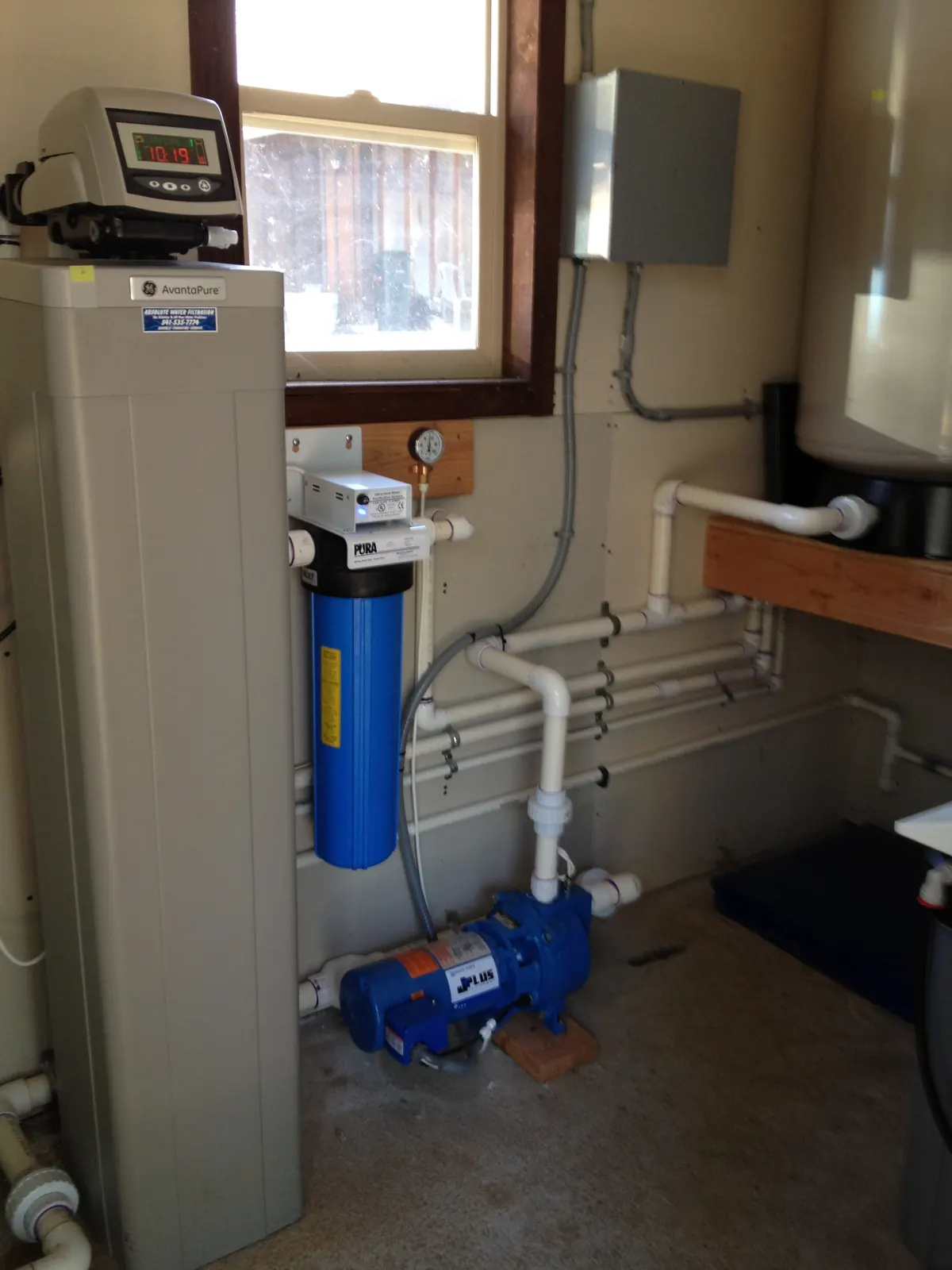
From a recent job.
Symptoms we see most often
- Rotten-egg smell at some or all faucets
- Black staining on fixtures and silver
- Corroded copper or galvanized pipe
- Smell stronger from the hot side only
Every hydrogen sulfide removal job
- On-site H2S and iron test
- Aeration or oxidation pretreatment as sized
- Catalytic carbon or greensand filter
- Annual service and shock chlorination if needed
Special considerations by city
Every city in our service area has its own water chemistry, source, and history. Pick your city for the specific numbers, regulations, and recommendations that shape how hydrogen sulfide removal should be configured at your address.
Eight cities served across the Rogue and Klamath basins. Tap a row to expand.
Medford
Medford Water is H2S-free at both Medford Water sources. The H2S story is in rural Jackson County wells, where "rotten egg" is regularly reported as the number-one well-water complaint in the region (Pure Water Solutions — Rotten egg smell).
Typical treatment stack is aeration or chlorine injection plus an iron filter or catalytic carbon. Many rural homes also have iron concurrent with H2S, which changes the sizing.
Ashland
Not a city-water problem at Ashland. Relevant for rural Jackson County wells in the hills outside Ashland — Dead Indian Memorial Road, Emigrant Lake area, outlying parcels on decomposed granite and metamorphic bedrock.
H2S is a routine regional well complaint but no Ashland-specific survey data is public. Diagnosis starts with distinguishing well-water H2S from a magnesium-anode water heater.
Central Point
Not an issue on Central Point city water (Medford Water, oxygenated and chlorinated). Relevant for rural Central Point and Agate Desert wells — local labs document H2S as a routine residential complaint caused by sulfate-reducing bacteria in groundwater (GP Water Lab — Hydrogen Sulfide).
A proper diagnosis distinguishes well-water H2S from water-heater-anode H2S before anything is installed.
Eagle Point
H2S is not a Medford Water city-supply issue in Eagle Point. For rural wells, Oregon Health Authority documents that iron, manganese, and hydrogen sulfide co-occur in reducing groundwater conditions common to this region, forming black iron-sulfide deposits (Oregon OHA — Iron and Manganese in Groundwater).
Rogue Valley water-testing labs explicitly list H2S as one of the top complaints from local well owners (The Water Lab — Rogue Valley). Wells in the Western Cascades volcanic bedrock east of Eagle Point are the classic setting.
Jacksonville
On Medford Water (city supply), H2S is not a concern. On private wells in the foothills, Ruch, Forest Creek, Applegate, and Kanaka Flats, H2S is a recurrent regional complaint per OSU Extension and local drillers.
The surrounding Mesozoic volcanic/metasedimentary bedrock is the classic reducing-condition aquifer. No Jacksonville-specific prevalence data is public — it's a well-by-well question.
Talent
Not a documented issue on Talent's Medford Water-supplied municipal system. For rural Talent and Bear Creek corridor wells, H2S appears in some reducing aquifers — typically handled with aeration or a catalytic-carbon/oxidizing filtration stack.
After the Almeda Fire, any well that sustained wellhead or plumbing damage should be tested broadly (the OHA free-testing program covered BTEX, bacteria, nitrate, arsenic, and lead) before concluding that a smell is "just H2S" (OHA — Wildfire-Impacted Well Testing).
White City
No public H2S survey data for the 97503 ZIP. H2S is plausible in reducing-condition wells in the Agate Desert alluvial/basalt aquifer, but is not documented at a community scale — it's a well-by-well question that requires individual testing.
For well owners, we flag H2S testing as part of a full well panel alongside arsenic and the VOCs that are the larger White City concern.
Phoenix
H2S is not a Medford Water city-supply issue in Phoenix. For private wells in the foothills and rural parcels east and south of town, hydrogen sulfide is a routine regional complaint — Oregon Health Authority documents that iron, manganese, and H2S co-occur in reducing groundwater common to this region (Oregon OHA — Iron and Manganese in Groundwater).
Diagnosis starts with distinguishing well-water H2S from a magnesium-anode water heater before any treatment is sized.
Shady Cove
H2S is a routine private-well complaint in the Shady Cove area. Oregon Health Authority documents that iron, manganese, and hydrogen sulfide co-occur in reducing groundwater conditions common to this region, often producing black iron-sulfide deposits at fixtures (Oregon OHA — Iron and Manganese in Groundwater).
Treatment depends on concentration: under 1 mg/L typically needs catalytic activated carbon alone; 1-5 mg/L needs aeration or oxidation plus a backwashing filter; above 5 mg/L needs a full oxidation plus filtration train. Diagnosis always distinguishes well-water H2S from a magnesium-anode water heater first.
Gold Hill
H2S is a recurrent rural-well complaint in the Sams Valley / Gold Hill / Foots Creek area. Oregon Health Authority documents that iron, manganese, and hydrogen sulfide co-occur in reducing groundwater conditions common to this region (Oregon OHA — Iron and Manganese in Groundwater).
Treatment is matched to concentration; iron-and-H2S co-occurrence calls for manganese greensand or Katalox Light rather than a plain softener (which fouls fast on H2S water).
Grants Pass
H2S is a recurrent private-well complaint in the Grants Pass area, particularly in the Williams, Murphy, and Applegate-foothill regions. Local labs document hydrogen sulfide as a routine residential complaint caused by sulfate-reducing bacteria in groundwater (GP Water Lab — Hydrogen Sulfide).
Treatment depends on concentration and on whether iron is also present. Diagnosis always distinguishes well-water H2S from water-heater anode-rod H2S first.
Klamath Falls
Klamath Falls is the only city in this list where H2S reaches past private drinking-water wells into the city's geothermal infrastructure. It sits on a Known Geothermal Resource Area, and more than 500 private geothermal heating wells serve over 600 structures (OSTI — Klamath Falls Geothermal).
Measured H2S in the geothermal water is approximately 1.5 mg/L and is documented as a primary cause of corrosion of mild steel, cast iron, copper, brass, and aluminum. While the drinking-water side of a home is separate from the geothermal loop, homes with geothermal heating deal with rotten-egg odor in the mechanical room and corrosion of anything metal the loop water touches. For private drinking-water wells, the same volcanic/geothermal geology that causes basin-wide arsenic makes H2S a realistic finding — especially in deeper wells that intersect warm groundwater.
Three visits. Done right.
- 01
Free on-site test
We test your tap or well for the contaminants that actually apply to your city and geology — not a generic 14-panel sticker.
- 02
Right-sized install
Flow rates, household size, and symptom priorities decide the system. Sourced from certified NSF manufacturers — never a one-size pitch.
- 03
Annual checkup
We come back once a year to swap media, retest the water, and catch anything small before it grows.